
Composition equipment of fully automatic biscuit production line
Automatic biscuits production line equipment is a complete set of equipment used for automatic and efficient production of biscuitss, which is mainly composed of the following parts:
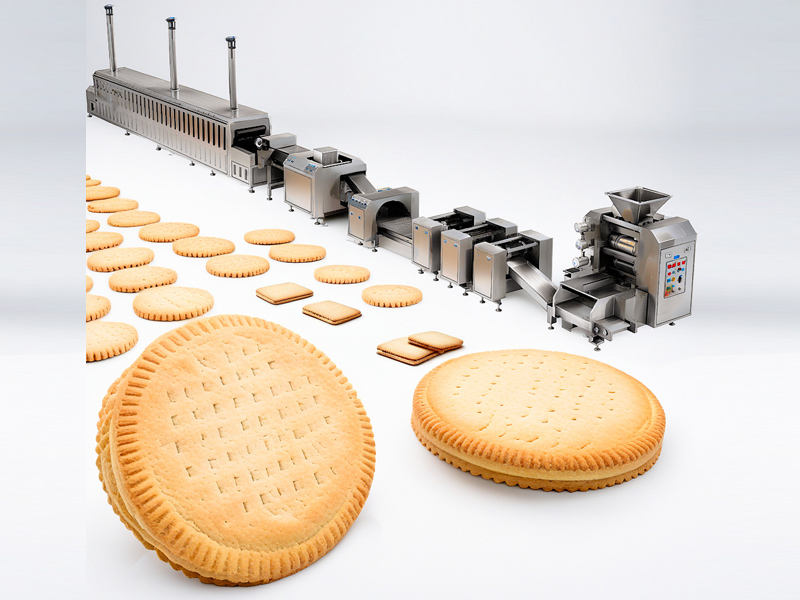
Raw material processing equipment
Mixing Machine
Function: Mixing and stirring the raw materials such as flour, sugar, grease, water, etc. to form a uniform dough.
Types: Horizontal mixing machine, vertical mixer, etc.
Forming equipment
Rolling machine Function: To roll the dough several times to make it uniform in thickness and suitable for subsequent molding.
Forming Machine
Tough Biscuit Forming Machine (Function of Roll Cutting Machine: Cut the dough strip into specific shape of biscuits blanks by rolling, suitable for tough biscuits production.
Function of crispy biscuits forming machine (roll-printing machine): by using roll-printing molds, the dough is embossed into various patterns and shapes of biscuits blanks, suitable for crispy biscuits production.
Function of Stacking Machine: Repeatedly stacking the calendered dough bands to increase the layering and crispness of the biscuitss, commonly used in soda biscuits production.
Baking Equipment
Function of Tunnel Baking Oven: Bake the biscuits blanks by electric, gas or far infrared heating to make them ripe and colorful.
Types: electric baking oven, gas baking oven, far-infrared baking oven, etc.
Post-processing equipment
Function of oil sprayer: spray grease or other liquids on the surface of biscuitss after baking to increase the taste and flavor.
Function of cooling line: to cool the biscuitss after baking, so that they can reach the appropriate packaging temperature.
Function of biscuits sorting machine: sorting and arranging the cooled biscuitss, removing non-conforming products.
Sandwiching machine Function: injecting sandwich filling for biscuitss, producing sandwich biscuitss.
Packing equipment
Function: pack the finished biscuitss to ensure the hygiene and shelf life of the products.
Control system
CPU module control Function: realize the automatic control of the production line, monitor the running status of each equipment, ensure the stability and high efficiency of the production process.
Features of biscuits production line
High degree of automation: from raw material input to finished product packaging, the whole process is automated, reducing manual operation.
High production efficiency: the equipment runs fast and has a large capacity to meet the needs of large-scale production.
Stable product quality: precise control of each process parameter to ensure consistent quality of each batch of products.
Strong flexibility: the parameters of the equipment can be adjusted according to different products and recipes to produce various types of biscuitss.
Energy saving and environmental protection: adopting advanced energy-saving technology to reduce energy consumption and production cost.
Application Scenarios
Large food processing plants: to meet the demand for large-volume, high-efficiency biscuits production.
Small and medium-sized biscuits producers: provide economical and practical production solutions to improve production efficiency and product quality.
Bakery: Suitable for producing specialty biscuitss to meet individualized demands.
Through the biscuits production line, enterprises can realize the automation and scale of biscuits production, improve production efficiency and product quality, reduce production costs and enhance market competitiveness.
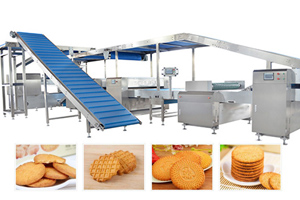
Price of biscuits production line
The price of biscuits production line varies greatly depending on factors such as equipment size, degree of automation, capacity and configuration, ranging from tens of thousands of dollars to millions of dollars. Below are the specific price ranges and corresponding types:
Price range of small biscuits production line
: about 20,000-100,000 RMB.
Characteristics: Suitable for start-ups or small-scale production, the output is generally below 100 kilograms per hour, the degree of automation is low, and part of the process may require manual operation.
Price range of medium-sized biscuits production line
: about 100,000-300,000 RMB.
Characteristics: Suitable for medium scale production needs, with capacity up to 100-500 kilograms per hour, with certain automation functions, such as automatic molding, baking and cooling.
Price range of large-scale automatic biscuits production line equipment: about 300,000-1,000,000 RMB and above.
Features: suitable for large-scale commercial production, output of more than 500 kilograms per hour, highly automated, covering the whole process from raw material handling to finished product packaging, equipped with advanced control system.
Factors affecting the price are the manufacturer’s technology, production capacity and configuration and material technology and the degree of automation of the production line:
Equipment brand: well-known brands are usually more expensive, but the quality and after-sales service is more guaranteed.
Capacity and configuration: the larger the capacity, the higher the configuration of the production line price is higher.
Degree of automation: fully automated production line is more expensive than semi-automatic or manual production line.
Material and process: the use of high-quality stainless steel materials and advanced technology equipment costs more.
Suggestion:
Choose a suitable production line according to your own production needs, budget and market positioning. Compare several to understand the performance, price and after-sales service of equipment from different manufacturers. Consider the long-term running cost and maintenance cost of the equipment.
Please note that the above prices are for reference only, and the actual purchase may vary depending on the specific configuration, market conditions and trading conditions. It is recommended that you contact the equipment manufacturer or supplier directly for a detailed quotation and proposal.
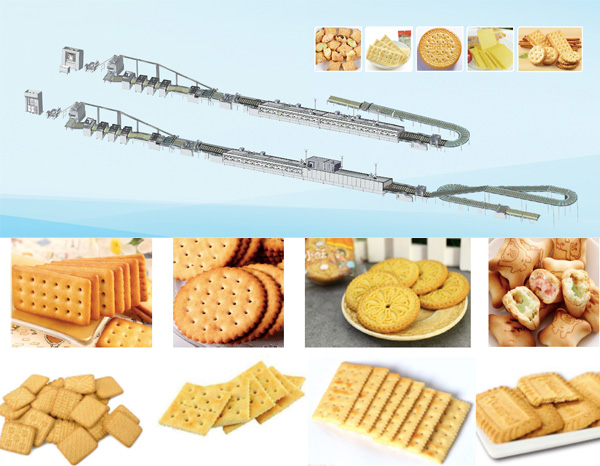
Types of Biscuit Production Line
Cookie production line can be classified into various types according to product type, production process and automation degree:
Classified by product type
- Firmness cookie production line
Product characteristics: low fat, crispy taste, such as soda cookie, thin crisp cookie.
Process flow: mixing → calendering → stacking (optional) → molding → baking → cooling → packaging.
- Shortening cookie production line
Product features: high fat, fluffy taste, such as cream cookie, cookies.
Process flow: mixing → molding → baking → oil spraying (optional) → cooling → packing.
- Sandwich Biscuit Production Line
Features: two pieces of cookies with filling in the middle, such as cream sandwich, jam sandwich.
Process flow: cookie production → sandwich injection → closing → cooling → packaging.
- Wafer Biscuit Production Line
Characteristics: distinct layers, crispy texture, such as waffles.
Process Flow: Flour mixing → pouring → baking → cooling → cutting → sandwiching (optional) → packing.
- Egg Roll Production Line
Characteristics: Egg is the main raw material, rolled into shape, crispy taste.
Process flow: mixing → pouring → baking → rolling → cooling → cutting → packing.
Classification according to the degree of automation
- Automatic Biscuit Production Line
Characteristics: from raw material input to finished product packaging, the whole process is automated, high efficiency, suitable for large-scale production.
Composition of equipment: including dough machine, molding machine, tunnel oven, cooling line, packaging machine, etc..
- Semi-automatic cookie production line
Characteristics: part of the process needs manual operation, such as dough preparation, molding or packaging, suitable for small and medium scale production.
Composition of equipment: part of the equipment is completed by manual assistance, and the degree of automation is low.
Classification according to capacity
- Small cookie production line
Capacity: output under 100kg per hour.
Applicable objects: start-up enterprises, small food processing factories or bakeries.
- Medium-sized cookie production line
Capacity: 100-500 kilograms per hour.
Applicable objects: medium-sized cookie production enterprises.
- Large-sized cookie production line
Capacity: hourly output above 500kg.
Applicable objects: large-scale food processing factories to meet the needs of mass production.
Other special types
- Multi-functional Biscuit Production Line
Features: It can produce many types of cookies and diversify products by changing molds and adjusting process parameters. - Intelligent cookie production line
Features: integrating IOT, big data and artificial intelligence technology to realize intelligent management and remote monitoring of the production process.
Enterprises can choose the right type of cookie production line according to their own product positioning, production scale, budget and market demand, in order to improve production efficiency and product quality, and meet the diversified market demand.
Advantages of Intelligent Biscuit Production Line
Intelligent cookie production line has many advantages, mainly reflected in the following aspects:
Improve production efficiency
Automated operation: from raw material placement to finished product packaging, the whole process is automated, reducing manual intervention and significantly increasing production speed and capacity.
Continuous and stable operation: the equipment runs stably, reduces downtime, realizes 24-hour uninterrupted production, and improves the utilization rate of the equipment.
Guarantee product quality
Precise control: adopting advanced control system, precise control of temperature, time, dosage ratio and other parameters to ensure stable product quality in each batch.
Quality Inspection: Integrated machine vision and sensor technology, real-time inspection of product appearance, size, weight, etc., automatically rejecting substandard products to ensure product consistency.
Reduce production cost
Reduce labor cost: high degree of automation reduces the dependence on operators and lowers labor cost and training cost.
Energy saving and consumption reduction: optimize the production process, adopt energy-saving equipment and technology, reduce energy consumption and raw material waste, reduce production costs.
Enhanced production flexibility
Fast switching: able to quickly adjust the production parameters and process flow to adapt to the production of different varieties and specifications of cookies to meet the diversified needs of the market.
Flexible production: it can flexibly adjust the production plan according to the order demand, realizing the production mode of small batch and multi-species.
Enhance food safety
Reduce human contamination: automated production reduces the chance of human contact with food, reduces the risk of cross-contamination, and improves product hygiene and safety.
Traceability: Establish a perfect traceability system to record the data of the whole production process, so that in case of problems, the cause can be quickly located and food safety can be guaranteed.
Optimize management decisions
Data support: real-time collection and analysis of production data, providing accurate information on yield, quality, energy consumption, etc., which provides the basis for management decisions.
Remote monitoring: Through the Internet of Things (IoT) technology, it realizes remote monitoring and management, grasps the production status anytime and anywhere, and adjusts the production strategy in time.
Enhance corporate image
Leading technology: Adopting intelligent production line, it demonstrates the technical strength and innovation ability of the enterprise and enhances the brand image and market competitiveness.
Environmental protection and energy saving: in line with the concept of green manufacturing, reduce environmental pollution, and establish a good image of social responsibility.
In summary, intelligent cookie production line has significant advantages in improving production efficiency, guaranteeing product quality, reducing costs, enhancing flexibility, improving food safety and optimizing management, which helps enterprises achieve sustainable development and enhance market competitiveness.
Maintenance of biscuits production line
The maintenance cost of a biscuits production line varies depending on the size and model of the equipment, the age of the equipment, and the frequency of production. Generally speaking, the maintenance cost mainly includes the following aspects:
- Daily maintenance costs
Cleaning and lubrication
Cleaning material costs: for removing accumulated dust, grease and food residues on the surface and inside of the equipment, which costs about US$20-50 per month.
Lubrication oil cost: for regular lubrication of transmission parts, chains, bearings, etc., which costs about US$10-30 per month.
Replacement of wearing parts
Regular wearing parts: such as conveyor belts, seals, blades, etc., cost about US$50-200 per month.
- Regular Maintenance Costs
Inspection and Maintenance
Professional Maintenance Labor Costs: Comprehensive inspection and maintenance every quarter or half a year costs about US$100-300.
Parts replacement: Replacement of worn or aged parts according to inspection results costs about US$200-500. - Annual overhaul cost
Comprehensive overhaul
Overhaul labor cost: annual comprehensive overhaul, including mechanical, electrical and pneumatic systems, etc., costing about US$500-1000.
Large parts replacement: e.g. motor, reducer, transmission system, etc. The cost depends on the specific situation and may be more than US$2,000. - Preventive maintenance cost
Spare parts reserve
Common spare parts: to ensure the continuity of production, reserve common spare parts, the cost is about 500-1000 USD. - Other costs
Training costs
Operator training: regular training for operators on equipment maintenance and operation, costing about US$100-200.
External service costs
Services of specialized maintenance companies: If the services of an external specialized company are required, the cost will depend on the specific situation.
Equipment brand and quality: High-quality equipment has relatively low maintenance costs, but the initial investment is higher.
Frequency of production: The higher the frequency of production, the faster the wear and tear of the equipment, and maintenance costs will increase accordingly.
Maintenance plan: the development of a reasonable maintenance plan, you can effectively reduce maintenance costs.
The above data is for reference only, the actual maintenance cost may vary depending on the specific situation. We suggest you to make a detailed maintenance budget and plan according to the actual situation of your own production line.