
How to choose automatic candy production line and manufacturer of gummy chocolate lollipop candy making machine
How to choose a fully automatic candy machine It depends on your needs. If you want to make gummies, you can process them through a casting candy production line. If you want to make hard candies, you usually use a die candy molding production line equipment. If you want to process lollipops, you can choose casting candy machinery equipment or hard candy processing equipment. Also, choose the machine according to the raw materials. If your raw materials have fluidity, you can use casting candy machines. If your raw materials are relatively solid, you need to use die candy processing equipment.
Of course, choosing the right candy machine is a crucial decision that will directly affect your product quality, production efficiency, and long-term operating costs. Here is a very systematic and practical guide to help you make wise choices step by step.
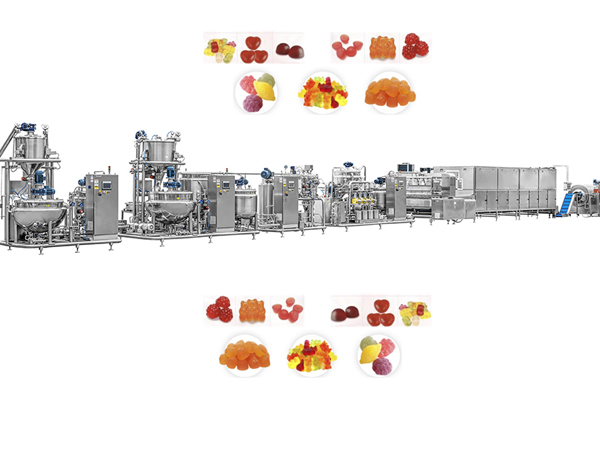
Type of Candy Product
To clarify your own needs, you must first have a clear understanding of yourself. You can create a requirement to organize your thoughts:
What candies are mainly produced
Hard candy, soft candy (gel candy), milk candy, toffee, tablet candy, chocolate?
Do you need special techniques such as sandwich, multi-layer, grouting, and flower drawing?
For example, the main functional gel jelly (similar to bear candy) needs jam sandwiches.
target capacity
What is the expected hourly or daily output in kilograms? This determines the scale and specifications of the production line. For example, the target output is 500 kilograms per hour.
degree of automation
Do you prefer fully automatic, semi-automatic, or manual operation? What is the level of acceptance of human intervention?
For example, if you want high automation, only 1-2 people are needed to operate the entire line.
budget range
What is the total budget for equipment procurement? Reserve for equipment costs, shipping fees, installation and commissioning, training, and possible spare parts expenses.
Candy factory conditions
Are the workshop area, floor height, power supply voltage (such as 380V), gas source, steam pressure/temperature, cold water and other infrastructure met?
For example, the workshop is 20m long and 8m wide, with 380V electricity and 0.6MPa steam.
Future planning of candy factory
Are there any plans to expand the product line (such as adding hard candies), increase production capacity, or upgrade technology in the next 1-3 years?
For example, we plan to add a small batch chocolate coating line in the next two years.
Only by clarifying your own needs can you communicate efficiently and professionally with manufacturers, and judge whether their solutions are truly suitable for you.
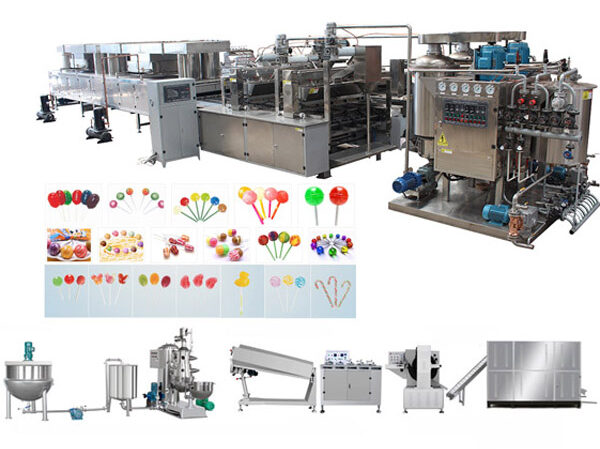
fully automatic lollipop production line
Screening Potential Manufacturers – Examining Key Indicators
Based on your needs, start searching and screening potential suppliers. Focus on the following aspects:
Matching degree between professional field and experience:
Find manufacturers that specialize in the candy type equipment you need. For example, manufacturers that are good at gel jelly production line may not have top equipment for hard candy. Assess their industry experience and customer cases. Request them to provide successful cases of producing similar products.
Technical capability and equipment performance:
Core technology: Does the equipment use PLC (programmable logic controller)+touch screen (HMI)? The PLC control system is more stable, intelligent, has a lower failure rate, and is more convenient for parameter adjustment than traditional relay control.
Key components: Understand whether the core components of the equipment (such as pumps, motors, sensors, pneumatic components, refrigerators, etc.) are from internationally or domestically renowned brands (such as Siemens, Mitsubishi, SMC, etc.). This is directly related to the long-term reliability and accuracy of the equipment.
Process adaptability: Can the equipment flexibly adjust parameters (temperature, pressure, flow rate, etc.)? Is it convenient to switch molds when replacing products? Is it convenient for future functional upgrades (such as adding sandwich devices)?
Manufacturing quality and materials:
Material: All parts in contact with food must be made of high-quality 304 or 316 stainless steel, and surface treatment (such as polishing, drawing) must meet food hygiene requirements and be easy to clean.
Processing technology: If conditions permit, it is necessary to visit the factory for on-site inspection. Check their production environment, assembly level, worker proficiency, and whether they have a complete quality inspection process.
Certification and Compliance:
Check if the manufacturer has obtained ISO9001 quality management system certification.
Confirm whether the equipment complies with mechanical safety and food hygiene standards such as CE (essential for export to Europe) and GB (Chinese national standards). These certifications are the fundamental guarantee for equipment quality and safety.
After sales service and support:
This is of utmost importance! Even the best equipment may require maintenance.
Service content: Do you provide free installation, debugging, operation, and maintenance training? Do you provide basic guidance on production processes and formulas? (Excellent equipment vendors are also your process consultants)
Response speed: What is the response mechanism of the after-sales team? Can 24-hour online support be provided? How to deal with emergency faults?
Spare parts supply: Are commonly used spare parts in stock? What is the price and lead time for purchasing spare parts?
In depth communication and evaluation – ask the right questions
Have in-depth communication with the selected key manufacturers. Don’t just listen to sales introductions, be sure to communicate with technical engineers and ask the following key questions:
How does your device ensure a key indicator, such as taste, flavor retention, and form stability, for my product type?
What are the maximum and minimum production capacities of the equipment?
What is the approximate energy consumption (electricity, gas, steam)?
What is the total floor area of the entire production line?
What kind of basic supporting facilities (water, electricity, gas) are needed? What is the lead time from placing an order to delivering and installing?
Can you provide a detailed draft of the after-sales service agreement?
Can you arrange for us to visit your factory or an existing customer’s factory to inspect the equipment operation on site?
Comprehensive decision-making – weighing the pros and cons
After receiving proposals and quotations from various companies, conduct a comprehensive comparison:
Don’t just look at the price: the lowest priced solution may be discounted in terms of material, configuration, and after-sales service. To calculate the comprehensive cost of the entire lifecycle.
Comparison of technical solutions: Which company’s technology better meets your process requirements? Which equipment is more forward-looking and flexible?
Assessing ‘feelings’: Which company is more professional, trustworthy, and willing to consider you in your interactions with others? Is communication smooth? This often indicates whether future cooperation will be pleasant.
Summary checklist:
Clarify one’s own product, production capacity, and budget requirements.
We have found several manufacturers that specialize in matching our expertise.
Verified its qualification certification (ISO9001, CE, etc.) and customer cases.
Confirmed that the equipment adopts PLC control and well-known brand components.
Confirmed that the equipment material is food grade stainless steel.
An on-site inspection of the manufacturer’s factory has been arranged or completed.
I have thoroughly understood the after-sales service terms (installation, training, response, spare parts).
We have compared multiple options and not made decisions based solely on price.
By following the above steps, you can systematically narrow down your selection range and ultimately find a reliable, professional, and long-term partner candy machine manufacturer.