
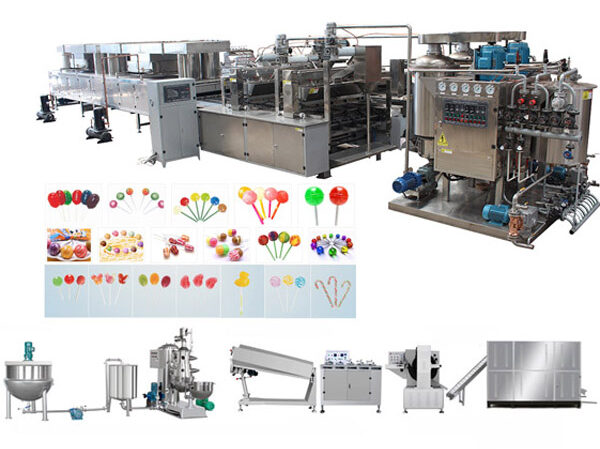
The fully automatic lollipop production line is a combination of equipment used for the automated and efficient production of lollipops. It mainly includes the following equipment and process flows:
Main Machinery of the Lollipop Production Line
The lollipop production line is a combination of equipment designed for automated, efficient production of lollipops, primarily comprising the following machinery and processes:
Main Equipment
Raw Material Processing Equipment
Sugar Melting Pot: Heats and dissolves raw materials such as white sugar and syrup, mixing them uniformly.
Sugar Boiling Machine: Boils the syrup, controlling temperature and concentration to ensure the syrup reaches the appropriate viscosity.
Forming Equipment
Pouring Machine: Injects the boiled syrup into molds to produce various types of lollipops, including single-color, two-color, and filled varieties.
Molds: Used to form the shape of the lollipops, with options including silicone molds and aluminum alloy molds.
Automatic Stick Insertion Machine: Automatically inserts lollipop sticks into the poured syrup.
Cooling and Demolding Equipment
Cooling Conveyor Belt: Rapidly cools and solidifies the formed lollipops.
Demolding Machine: Removes the cooled lollipops from the molds.
Packaging Equipment
Packaging Machine: Automatically packages the finished lollipops to ensure hygiene and aesthetics.
Control System
PLC Control System: Automates the entire production line, monitors various parameters during the production process, and ensures production efficiency and product quality.
Process Flow Of Lollipop Candy Production Line
Raw Material Preparation and Mixing
Mix white sugar, syrup, water, food coloring, and flavorings in the correct proportions in a sugar melting pot, heat to dissolve, and stir until uniform.
Sugar Boiling
Transfer the mixed syrup to a sugar boiling machine and boil under vacuum conditions, controlling temperature and time to achieve the desired concentration and texture.
Pouring and Molding
Pouring: The boiled syrup is injected into pre-prepared molds via the pouring machine.
Stick insertion: The automatic stick insertion machine inserts lollipop sticks into the syrup before it fully solidifies.
Cooling and Demolding
Cooling: Lollipops with molds enter a cooling tunnel or conveyor belt to rapidly cool to room temperature, solidifying the syrup into shape.
Demolding: Cooled lollipops are removed from the molds by a demolding machine and undergo preliminary sorting.
Quality Inspection
Demolded lollipops undergo quality inspections for appearance, weight, and taste, with non-conforming products removed.
Packaging
Qualified lollipops are automatically packaged by a packaging machine, with options for bagged, boxed, or other forms, ensuring hygiene and safety during transportation and sales.
Finished Product Storage
Packaged lollipops undergo final inspection before being stored in the warehouse or shipped directly.
Features of the Lollipop Production Line
High Automation: Reduces manual labor, improves production efficiency, and ensures product consistency.
High Flexibility: Allows for mold and production formula changes to produce lollipops of different flavors, shapes, and colors.
Hygiene and Safety: Complies with food GMP standards to ensure product quality and food safety.
By reasonably configuring and optimizing the lollipop production line, companies can meet market demands, enhance competitiveness, and maximize economic benefits.
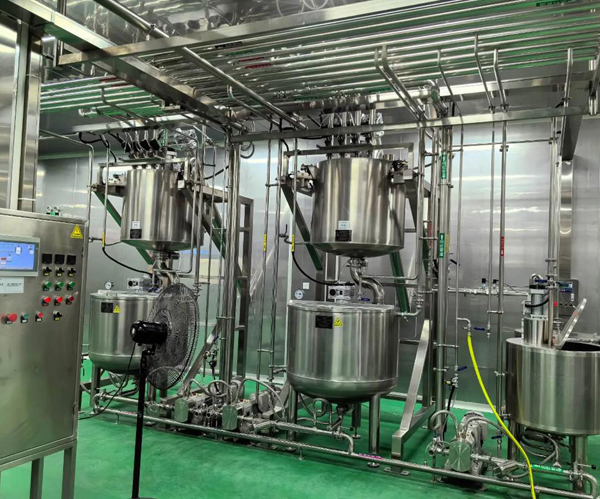
Capacity Of Lollipop Production Line
The capacity of lollipop production lines varies depending on the equipment model and configuration. The general capacity ranges are as follows:
Small-scale Lollipop Production Line
Capacity: Approximately 150–300 kg/hour
Features: Suitable for startups or small-scale production, with relatively low equipment investment and a small footprint.
Medium-scale Lollipop Production Line
Capacity: Approximately 300–600 kg/hour
Features: Suitable for medium-sized enterprises, with a certain degree of automation, high production efficiency, and product quality.
Large-scale lollipop production line
Production capacity: Over 600 kilograms per hour, with some capable of reaching 2.5 tons per 8 hours
Features: Suitable for large-scale production enterprises, highly automated, equipped with advanced control systems, enabling efficient and stable production.
Actual production capacity may also be influenced by the following factors:
Equipment performance: Different manufacturers’ equipment may vary in technical capabilities and production efficiency.
Product specifications: The weight, shape, and whether the lollipop has a filling can affect production speed.
Manual operation: The skill level and coordination of operators can also impact actual production capacity.
It is recommended to select a suitable lollipop production line based on your specific needs and to discuss production plans in detail with the equipment supplier.
Energy consumption of lollipop production lines
The energy consumption of lollipop production lines mainly depends on factors such as production scale, equipment configuration, and process technology. The following are the main energy consumption situations:
Types of energy consumption
Electricity
Driving equipment: Operation of equipment such as mixers, molding machines, stick insertion machines, cooling conveyor belts, and packaging machines.
Control systems: PLC control systems, temperature controllers, etc.
Lighting and ventilation: Lighting and ventilation equipment in production workshops.
Thermal Energy
Raw Material Heating: Equipment such as sugar melting pots and sugar boiling machines requires heating raw materials to a certain temperature, commonly using steam, natural gas, or electricity.
Cooling Systems: Cooling tunnels or cooling equipment may require energy to operate refrigeration systems.
Factors Affecting Energy Consumption
Production Scale
Small-Scale Lollipop Production Line: Lower production capacity, relatively smaller equipment power, and overall lower energy consumption.
Large lollipop production line: High production capacity, multiple equipment units, and high automation levels result in relatively higher energy consumption.
Equipment Efficiency
High-efficiency equipment: Utilizes energy-efficient motors, high-efficiency heating elements, etc., resulting in lower energy consumption.
Outdated equipment: Technologically obsolete, resulting in higher energy consumption.
Process Technology
Advanced processes: Such as vacuum sugar boiling technology and waste heat recovery utilization, which can reduce energy consumption.
Traditional processes: Relatively high energy consumption.
Production Time and Load
Continuous production: High equipment utilization rate, lower energy consumption per unit of product.
Intermittent production: Frequent equipment starts and stops, increased energy consumption.
Energy Consumption Optimization Measures
Select energy-efficient equipment
High-efficiency motors: Use motors compliant with national energy efficiency standards.
Energy-saving heating equipment: Adopt efficient heating methods such as electromagnetic heating and infrared heating.
Optimizing process flows
Improving sugar boiling processes: Controlling sugar boiling temperature and time to reduce energy waste.
Waste heat recovery: Utilizing waste heat generated during production to preheat raw materials or heat water.
Strengthening energy management
Energy monitoring systems: Real-time monitoring of energy consumption to promptly identify and address energy waste issues.
Energy-saving training programs: Enhancing operators’ energy-saving awareness and operational skills.
Reference data
Taking a medium-sized lollipop production line as an example, with an hourly capacity of approximately 500 kilograms:
Electricity consumption: approximately 50–100 kilowatt-hours
Thermal energy consumption: approximately 200–400 kilowatt-hours (calculated based on equivalent electrical energy)
Note: The above data is for reference only; actual energy consumption may vary due to factors such as equipment, process, and production conditions.
By implementing effective energy-saving measures, it is possible to significantly reduce energy consumption in lollipop production lines, improve energy utilization efficiency, lower production costs, and achieve a win-win outcome for both economic and environmental benefits.
How to Optimize the Lollipop Production Line to Reduce Energy Consumption
To optimize the lollipop production line process and reduce energy consumption, the following aspects can be addressed:
Equipment Upgrades and Optimization
Adopting High-Efficiency Energy-Saving Equipment
Using high-efficiency energy-saving motors and variable frequency drives to reduce electrical energy consumption of drive equipment.
Upgrading sugar boiling equipment, such as adopting vacuum sugar boiling machines or electromagnetic heating equipment, to improve thermal efficiency, reduce heating time, and lower energy consumption. Select energy-efficient cooling systems, such as high-efficiency cooling towers or air-cooled equipment, to reduce energy consumption during the cooling process.
Equipment Maintenance and Inspection
Regularly maintain and inspect equipment to ensure it operates at optimal performance, minimizing energy waste caused by equipment aging or malfunctions.
Process Improvements
Optimize the sugar boiling process
Precisely control boiling temperature and time to avoid overheating and reduce energy consumption.
Adopt continuous production processes to minimize equipment start-stop cycles and improve equipment utilization.
Waste Heat Recovery and Utilization
Utilize waste heat generated during the sugar boiling process to preheat raw materials or heat water, improving energy utilization efficiency.
Optimize the Cooling Process
Control cooling time and temperature to avoid overcooling and reduce energy consumption in the cooling system.
Adopt a staged cooling method to gradually lower product temperature and improve cooling efficiency.
Energy Management
Energy Monitoring and Analysis
Install an energy management system to monitor energy consumption on the production line in real time, analyze energy consumption data, and identify areas of energy waste.
Develop targeted energy-saving measures based on analysis results.
Energy-Saving Training Program
Provide energy-saving training to operators to enhance their energy-saving awareness and operational skills, ensuring equipment operates under optimal conditions.
Raw Material and Formula Optimization
Optimize Raw Material Ratios
Determine optimal raw material ratios through experimentation to reduce material waste and improve product yield.
Use high-efficiency food additives to improve syrup flowability, thereby lowering boiling temperature and time.
Production Planning and Scheduling
Reasonably arrange production schedules
Based on market demand and production equipment capacity, reasonably arrange production schedules to avoid equipment running at idle or low load.
Optimize production batches to reduce equipment changeover frequency and improve production efficiency.
Through the comprehensive application of the above measures, energy consumption in the lollipop production line can be effectively reduced, energy utilization efficiency improved, production costs lowered, and the company’s economic benefits and market competitiveness enhanced.