
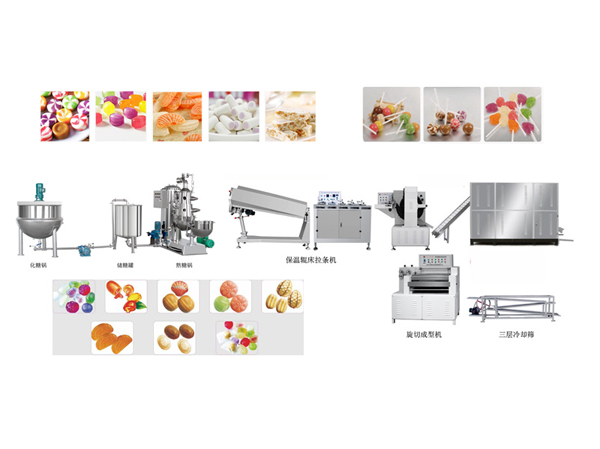
Methods for Ensuring Accuracy in the Dosing of Flavorings, Colorings, and Acid Solutions on a Lollipop Production Line
Accurate ingredient measurement involves two key stages: precise pre-mixing in storage tanks and accurate addition to the sugar paste. This goes beyond mere weighing; it also addresses issues such as separation, crystallization, air bubbles, pump drift, residue, and evaporation—all of which can lead to a situation where “the displayed value is correct, but the actual amount added is incorrect.” The process is divided into five major categories: manual batching, automatic metering, process control, verification and error prevention, and equipment maintenance.
I. Pre-mixing Stage: Ensuring the Accuracy of the Stock Solution Concentration
Flavorings, colorants, and acids are typically prepared as stock solutions before being added. If the stock solution is incorrect, even the most precise downstream processes will be ineffective.
- Prepare stock solutions by weighing, not by volume using measuring cups or graduated cylinders
Liquid materials vary in density, and their volume changes with temperature; the weight method is far superior to the volume method. When preparing citric acid solutions or diluting compound colorants, always use an electronic scale to weigh and record the amounts; estimating quantities by eye using graduated buckets is strictly prohibited. - Equip stock solution storage tanks with low-speed agitators
- Pigments: Maintain continuous low-speed agitation to prevent sedimentation and separation; agitate before starting production at the beginning of each shift.
- Acid solutions (citric acid): Maintain the storage tank at 35–45°C to prevent crystallization at low temperatures; crystallization can cause a decrease in the actual concentration during pipeline transport.
- Flavoring agents: Keep storage tanks sealed to minimize volatilization losses; open storage is strictly prohibited.
- Label the mother liquor, record the preparation time and concentration, and periodically verify the concentration; if the acid solution has been stored for a long time, stir it again; if crystallization occurs, redissolve it before use.
II. Selection of Material Dosing and Measurement Methods (Ordered from Low to High Precision)
- Manual Weighing and Dosing (Small-Batch Batch Kettles)
Suitable for small-capacity sugar-cooking kettles
- Use electronic scales that have passed verification and are regularly calibrated; Ensure the weighing platform is level to avoid vibration interference.
- Use the weight-difference method for dosing: Weigh the total weight of the material container, then weigh the remaining weight after dosing is complete to calculate the actual amount added; do not rely solely on the weight before dosing. Material adhering to the container walls is a source of error; the weight-difference method accounts for this loss.
- Do not use spoons to scoop materials or estimate based on liquid level markings.
- Peristaltic Pumps/Diaphragm Pumps and Flow Calibration (Medium-to-Large Production Lines, Low-Flow Additives)
Flavorings, colorants, and acids are all added in small volumes, and pumps are prone to drift.
- Calibrate before startup and periodically verify flow rates during production; do not rely on a single calibration for the entire day. It is recommended to perform a calibration with actual material every 2–3 batches: have the pump deliver the material into a receiving bucket, weigh the actual output, and compare it to the set value.
- Install air release valves at the highest points in the piping to purge air bubbles; air bubbles can cause the pump to run dry, resulting in a set flow rate that is not actually being delivered to the sugar paste.
- Materials: Use 316L stainless steel and acid-resistant EPDM seals for all components in contact with acids; establish replacement schedules for O-rings and peristaltic pump tubing; replace them immediately upon signs of aging—do not wait until leakage occurs.
- Position the pump outlet as close as possible to the mixing kettle to shorten the transfer piping and minimize residue in the lines.
- Loss-in-Weight Feeder (Recommended First; High Stability)
For small-dose, heat-sensitive additives such as flavorings, colorants, and acids, a loss-in-weight feeder is more resistant to interference from air bubbles and crystallization than a flow pump.
Principle: The entire storage tank is placed on a load cell. The tank’s weight is monitored in real time during production, and material is fed based on weight consumption, unaffected by material viscosity or air bubbles.
Suitable for both continuous and batch sugar boiling processes;
Upper and lower deviation alarms can be set; the system will trigger an alarm and shut down immediately if the actual feed rate deviates beyond the set range.
Standard rotor flowmeters are not recommended for flavorings, colorants, and acids: even small amounts of crystallization or air bubbles can cause measurement errors.
III. Process and Ingredient Feeding Control: Eliminating the Issue of “Accurate Measurement Values but Inaccurate Active Ingredients”
Often, equipment displays that the feed quantity meets standards, yet the finished product fails inspection. This constitutes a loss of active ingredients and is equivalent to inaccurate formulation.
- Strictly Control Feeding Temperature: Sugar paste must be cooled to 105–115°C before adding flavorings, acids, and colorants. If the temperature is too high, flavorings will evaporate, acids will decompose, and colorants will degrade. Even if the ingredients are added, the active ingredients will be reduced, which is equivalent to under-formulation. Record the sugar syrup feeding temperature for each batch.
- Ensuring Proper Feeding Sequence and Mixing
Sequence: Colorants → Acid solution → Flavorings; after all ingredients have been added, ensure sufficient mixing time and confirm that the sugar syrup is uniform before pouring.
Insufficient mixing results in ingredients being merely added without proper dispersion, leading to color and flavor inconsistencies within the same batch. - Changing Flavors/Colors: Piping and static mixers must undergo CIP (Clean-in-Place) rinsing. After rinsing, drain residual water from the piping, take samples for verification, and eliminate residual contamination from the previous batch.
IV. Verification, Record-Keeping, and Error-Proofing Measures
- Three-Level Verification Mechanism
① Signature of the verifier for stock solution preparation; ② Record the theoretical consumption for each batch; ③ Compare with actual consumption (change in tank weight).
Comparison: Theoretical requirement vs. actual consumption; if the deviation exceeds ±2%, halt production for investigation; production must not continue. - First-Article Inspection System
For each production batch, conduct a sensory comparison (color, aroma, acidity) on the first lollipops produced; proceed with mass production only after they pass inspection; do not wait until the entire batch is produced before testing. - Alarm Settings: The automated production line is equipped with deviation alarms; audible and visual alarms trigger when the feed rate exceeds the allowable range, and the system may even interlock to pause the pouring process.
- Periodic Calibration: Electronic scales and loss-in-weight scale sensors must be calibrated by the metrology bureau at specified intervals; pump calibration records must be archived.
V. Common Hidden Errors (Easily Overlooked on the Production Floor)
- Residues in Piping and Valve Chambers: When switching batches, some material remains in the piping and does not enter the candy mixture, resulting in an actual reduction in feed volume.
- Open-Top Flavoring Tanks: Effective aromatic components evaporate, leading to insufficient flavor even when the same weight of material is added.
- Acid Solution Crystallization: The pump delivers water, while crystals remain in the tank and piping, causing the mother liquor concentration to continuously decrease.
- Calibration using water instead of actual production materials (flavorings or acid solutions). Since water and the materials have different viscosities, the calibration results are distorted; calibration must use the actual production materials and cannot be substituted with water.
Quick Selection Recommendations
- Small-capacity batch sugar kettles: Use the loss-on-weight method with manual weighing for ingredient addition, and maintain accurate weight loss records;
- Medium- to large-scale batch production lines: Prioritize loss-in-weight scales; if budget is limited, use peristaltic pumps and strictly perform calibration with actual product every 2–3 batches;
- Continuous sugar boiling and pouring production lines: Prioritize loss-in-weight dosing systems, paired with static mixers, equipped with venting, and perform periodic calibration with actual product.