
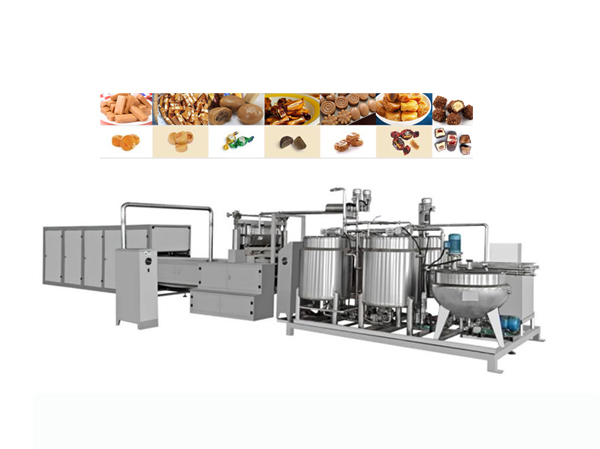
main equipment of toffee production line
Toffee making machines are used for the efficient and automated production of toffee, and include the following machines: boiling machines, cooling and whitening machines, molding machines, chain molding machines for cutting and molding sugar bars into toffee granules, cooling and conveying machines, and packaging machines.
Boiling Machine
Toffee Boiling Machine mixes and heats sugar, water, cream and other ingredients to make a thick sugar paste.
Features: steam or electric heating, equipped with scraping and stirring device to prevent the sugar paste from scorching and ensure even boiling.
Cooling & Pulling White Machine
Cooling Platform
Cool the boiled sugar paste to suitable temperature.
White pulling machine stretches and kneads the cooled sugar paste to make it fine in texture and even in color.
Molding Machine
Candy Extruder Extrudes the sugar paste into strips for subsequent molding.
Strip equalizer adjusts the diameter of sugar strips to ensure consistent size.
Chain molding machine cuts and molds the sugar bars into toffee pellets.
Characteristics: Suitable for sandwich toffee, avoiding leakage, bursting and other problems, and improving production efficiency.
Cooling & Conveying Machine
Cooling & Conveying Table cools the molded toffee to room temperature.
Cooling cabinet: further cooling to ensure the toffee hardened and shaped.
Packing Machine
Packing machine packs the cooled toffee to extend the shelf life.
Types: Pillow wrapping machine, Twist wrapping machine, etc.
Auxiliary Machines
The pulp delivery pump quantitatively delivers the sandwich filling and controls the amount of sandwich.
Automatic stick insertion system inserts paper sticks during toffee molding process, suitable for lollipop production.
The above machines can be combined according to the production demand to realize the automatic production of toffee. When selecting machines, factors such as production capacity, automation degree, product quality and hygiene standard should be considered to meet the production requirements.
Types of Toffee Candy
Toffee is a popular western candy with a wide variety of types that can be classified according to flavor, ingredients and production process:
Classification by Flavor
Original Toffee: Made with basic ingredients such as condensed milk, cream and sugar, it has a rich and sweet taste and is the most classic flavor.
Chocolate toffee: add cocoa powder or chocolate, a blend of chocolate mellow and sweet original flavor, loved by chocolate lovers.
Nut Toffee:
Peanut Toffee: Peanuts are added to add crunch and peanut flavor.
Almond Toffee: Add almonds to add crunchy flavor and more nutritious.
Hazelnut Toffee: add hazelnuts for a unique nutty flavor.
Fruity Toffee:
Strawberry Toffee: infused with the tartness of strawberries for a refreshing taste.
Orange Toffee: With orange extract, it has a refreshing and fruity flavor.
Pineapple toffee: with the sweetness of pineapple, it has a unique flavor.
Specialty Flavors Toffee:
Sea Salt Toffee: With the addition of appropriate amount of sea salt, it is sweet and salty with a rich taste.
Coffee Toffee: With the addition of coffee powder, it has a rich coffee aroma.
Matcha Toffee: Add matcha powder, fresh and light, with the unique flavor of matcha.
Black Tea Toffee*: incorporating black tea extract, with strong tea flavor and mellow taste.
Categorized by ingredients
Milk Toffee:
Milk as the main ingredient, with a delicate and soft taste, and a rich milky flavor.
Caramel Toffee:
Caramel is added during the production process, which makes the color darker and the taste more mellow, with the unique flavor of caramel.
Sugar Free Toffee:
Uses sugar substitutes instead of traditional sugar, suitable for diabetics or people who control their sugar intake.
Categorized by production process
Soft toffee: Soft inside with a delicate texture, usually containing a fudge heart or sandwich.
Hard toffee: Harder, chewy and more solid in texture.
Crunchy toffee: with nuts or crushed cookies for a crunchy, rich texture.
Specialty Varieties
Saltwater Toffee: a specialty of Atlantic City, legend has it that it was named after the toffee store that was flooded by the sea. The taste is unique, with a mix of sweet and salty.
Earthworm Taffy: A fun toffee that resembles an earthworm on the outside, often used for children’s candy or special occasions.
There are a variety of toffees to satisfy the taste needs of different people. Whether enjoyed as a snack or given as a gift, they are a good choice.

Taste differences between different toffee processes
Different processing techniques have a significant impact on the taste of toffee, which is mainly reflected in the following aspects:
Simmering temperature and time
High temperature and short time simmering (150℃-160℃):
Taste: the syrup is rapidly dehydrated, forming a harder texture and crispy taste.
Flavor: high temperature produces a caramel flavor, strong aroma, but prone to burnt taste.
Long simmering at low temperature (80℃-90℃ for several hours):
Mouthfeel: water evaporates slowly, the syrup has a soft texture and a fine, smooth taste.
Flavor: full integration of flavor substances, mellow taste, caramel flavor is light.
Stirring mode
Continuous stirring Taste: prevent sugar crystallization, make the syrup uniformly thick and delicate.
Texture: Increase the toughness and elasticity of the syrup.
Intermittent stirring or no stirring Taste: Sugar crystallization may occur, rough texture, uneven taste.
Cooling speed
Rapid cooling:
Mouthfeel: rapid solidification of the syrup, harder texture, crunchy mouthfeel.
Structure: Reduced crystallization, tight internal structure.
Slow cooling:
Mouthfeel: syrup has more time to crystallize, softer texture, soft mouthfeel.
Structure: Loose internal structure, soft mouthfeel.
ADDITIVES AND SUBSIDIARIES
Butter, Cream:
Mouthfeel: adds lubrication and makes the toffee taste more delicate and soft. Nuts, Chocolate:
Mouthfeel: Add layers of texture to enhance crispness or richness.
Sea Salt:
Mouthfeel: Adjusts sweetness, brings balance between salty and sweet, and adds layers of flavor.
Processing
Traditional Boiling:
Mouthfeel: Intense flavor and variety of textures, but mouthfeel may be inconsistent.
Continuous Production Line:
Mouthfeel: Good product consistency and stable texture, but may have a single flavor.
Low Temperature Slow Cooking:
Mouthfeel: Delicate and smooth texture, mellow flavor, but longer production time.
Vacuum boiling method:
Mouthfeel: uniform texture, fine taste, more uniform color, but the cost of equipment is higher.
Summary:
The choice of processing technology directly affects the taste and flavor of toffee. By controlling the boiling temperature, time, stirring mode, cooling speed and adding auxiliary materials, you can make soft, crispy, delicate or layered toffee to meet different consumer preferences.