
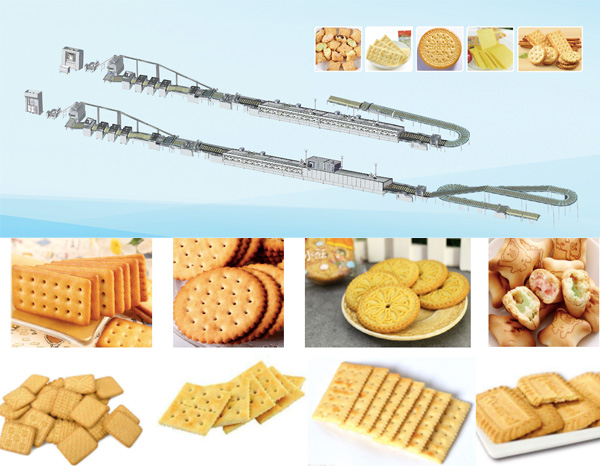
How to Choose the Right Biscuit Machine
Selecting the right biscuit production equipment requires consideration of multiple key factors to ensure the equipment meets production needs, improves efficiency, and controls costs.
Determine Production Requirements
Product Type:
biscuit Types: Determine the primary types of biscuits to be produced, such as crispy biscuits, flaky biscuits, biscuits, filled biscuits, etc.
Product Characteristics: Consider the shape, size, thickness, and texture of the biscuits, as different equipment has varying adaptability to product characteristics.
Production Scale:
Production Volume Requirements: Estimate the expected daily and monthly production volume and select equipment with matching production capacity.
Production Method: Determine whether it is intermittent or continuous production, which affects equipment selection and configuration.
Equipment Performance and Functionality
Equipment Type:
Forming Equipment: Select suitable forming machines based on the product, such as roller printing machines, stamping machines, or extrusion forming machines.
Baking Equipment: Choose tunnel ovens, rotary ovens, etc., considering baking effects and energy consumption.
Packaging Equipment: Select pillow packaging machines, vertical packaging machines, etc., based on packaging requirements.
Automation Level:
Fully Automatic vs. Semi-Automatic: Fully automatic equipment is highly efficient but has higher costs; semi-automatic equipment is suitable for small-scale production and offers greater flexibility.
Technical Parameters:
Production Capacity: Whether the equipment’s production capacity aligns with the expected production volume.
Precision: Does the processing precision of the equipment meet product quality requirements?
Stability: The operational stability and reliability of the equipment.
Cost and Budget
Equipment Price:
Initial Investment: Compare the prices of different brands and models of equipment and select cost-effective equipment.
Operating Costs:
Energy Consumption: The energy consumption of the equipment, such as electricity and gas.
Maintenance Costs: The maintenance and repair costs of the equipment, including spare part prices and availability.
Return on Investment: Evaluate the equipment’s return on investment cycle to ensure economic feasibility.
Equipment Quality and Suppliers
Brand Reputation:
Well-Known Brands: Select suppliers with a good reputation and extensive experience to ensure equipment quality and after-sales service reliability.
After-Sales Service:
Technical Support: Whether the supplier provides timely technical support and maintenance services.
Training Services: Whether training is provided for equipment operation and maintenance.
Site Visits:
Factory Tours: Visit the supplier’s production facilities and customer sites to understand the actual operational status of the equipment.
User Feedback: Collect evaluations and usage experiences from other users.
Adaptability and Scalability
Equipment Compatibility:
Production Line Integration: Whether the equipment can be integrated with existing or planned equipment to form a complete production line.
Product Diversity:
Multifunctionality: Whether the equipment has the capability to produce multiple products, facilitating future product expansion.
Space Layout:
Footprint: Whether the equipment’s dimensions are suitable for the existing production workshop’s space layout.
Regulations and Standards
Compliance with Standards:
Food Safety: Does the equipment meet food hygiene and safety standards? Are the materials corrosion-resistant and easy to clean?
Environmental Requirements: Does the equipment comply with environmental regulations, such as noise and emissions?
By comprehensively considering the above factors and combining them with your actual circumstances, you can select suitable biscuit production equipment to enhance production efficiency and product quality, laying a solid foundation for the long-term development of your enterprise.
Categories of biscuit processing machine
biscuit processing machinery comes in a wide variety of types. Based on their functions and production processes, they can primarily be categorized into the following categories:
Raw Material Processing Equipment
Dough Mixers
Function: Mixes raw materials such as flour, sugar, fats, and water uniformly to form dough suitable for processing.
Types: Horizontal mixers, vertical mixers, vacuum dough mixers, etc.
Forming Equipment
biscuit Forming Machine
Chewy biscuit Forming Machine
Function: Rolls the dough into thin sheets using multiple rollers, then cuts or stamps it into shape.
Features: Suitable for producing soda biscuits, chewy biscuits, etc.
Crispy biscuit Forming Machine
Function: Uses roller imprinting or stamping to form biscuits in one step, producing biscuits with clear patterns.
Features: Suitable for producing shortbread biscuits, biscuits, etc.
Filled biscuit Forming Machine
Function: Places jam, cream, or other fillings between two biscuit layers to form filled biscuits.
Features: Can produce various flavors of sandwich biscuits.
Baking Equipment
Tunnel Oven
Function: Continuously bakes biscuits through a tunnel-shaped heating chamber.
Features: High production efficiency, suitable for large-scale production.
Hot Air Rotating Oven
Function: Uses hot air circulation to ensure even heating of biscuits.
Features: Suitable for medium and small-scale production lines, with excellent baking results.
Post-processing Equipment
Oil Sprayer
Function: Evenly sprays oil or other liquids onto the surface of biscuits to improve texture and appearance.
Features: Adjustable oil spray volume to meet the needs of different biscuits.
Cooling Line
Function: Cools baked biscuits to achieve an appropriate packaging temperature.
Features: Typically uses a mesh belt conveyor for efficient cooling.
Sorting Machine
Function: Arranges cooled biscuits neatly for packaging.
Features: High degree of automation to improve packaging efficiency.
Packaging Equipment
biscuit Packaging Machine
Function: Performs packaging operations such as weighing, bagging, sealing, and printing dates on biscuits.
Types: pillow-style packaging machine, vertical packaging machine, fully automatic packaging production line, etc.
Auxiliary Equipment
Sprinkling Machine
Function: Sprinkles sugar granules, salt granules, sesame seeds, and other additives onto the surface of biscuits.
Features: Precisely controls the amount of sprinkled additives to enhance biscuit flavor.
Curving Machine
Function: Connects different equipment in the production line to achieve curved conveying.
Features: Saves space and facilitates layout.
Specialized biscuit Production Equipment
Wafer biscuit Production Line Function: Specifically designed for producing wafer biscuits, including dough sheet production, filling, and cutting processes.
Compressed biscuit Production Line
Function: Produces high-density compressed biscuits, commonly used for outdoor food.
By reasonably selecting and configuring these devices, different types of biscuit processing requirements can be met, improving production efficiency and product quality.
Maintenance plan of biscuit making machine
Developing a maintenance plan for equipment is crucial to ensuring its long-term stable operation, extending its service life, and improving production efficiency. The following are the detailed steps:
- Equipment Information Collection and Assessment
- Collect equipment information
Equipment records: Establish equipment ledgers to record basic information such as equipment model, specifications, manufacturer, date of manufacture, years of use, and technical parameters.
Historical Records: Organize the equipment’s operational records, maintenance records, fault history, and maintenance records to understand its operational status and fault patterns. - Equipment Assessment
Importance Classification: Classify equipment based on its criticality in production into critical equipment, important equipment, and general equipment.
Risk Assessment: Assess the impact of equipment failures on production, quality, and safety to determine maintenance priorities. - Developing Maintenance Strategies
- Determine Maintenance Types
Preventive Maintenance: Regularly perform cleaning, lubrication, inspections, and adjustments based on time and usage cycles to prevent failures.
Predictive Maintenance: Utilize monitoring technologies such as vibration analysis and temperature monitoring to predict equipment status and take proactive measures.
Corrective Maintenance: Emergency repairs following equipment failures. - Select Maintenance Methods
Daily Maintenance: Performed by operators, including basic tasks such as cleaning, tightening, and lubrication.
Scheduled Maintenance: Conducted by professional maintenance personnel according to a plan, such as Level 1 maintenance, Level 2 maintenance, etc.
Specialized Maintenance: Maintenance targeting specific components or systems, such as hydraulic system maintenance, electrical system maintenance, etc.
III. Setting Maintenance Cycles and Content
- Determining Maintenance Cycles
Time-Based Method: Determining maintenance cycles based on equipment operating time, such as every 100 hours, monthly, quarterly, etc.
Performance Decline Method: Determine maintenance timing based on the decline in equipment performance indicators, such as reduced precision or efficiency.
Manufacturer Recommendations: Refer to the maintenance cycle recommendations provided by the equipment manufacturer. - Develop Maintenance Content
Cleaning: Remove dust, dirt, and debris from inside and outside the equipment to maintain cleanliness.
Lubrication: Regularly add or replace lubricating oil to ensure proper lubrication of moving parts.
Inspection: Inspect equipment fasteners, transmission components, electrical systems, etc., to identify and eliminate potential hazards.
Adjustment: Adjust equipment parameters and accuracy to ensure the equipment is in optimal condition.
Replacement of Wear Parts: Regularly replace wear parts, such as filters, seals, and belts.
IV. Develop a Maintenance Plan
- Create a Schedule
List equipment: Clearly define the maintenance items, cycles, responsible parties, and execution times for each piece of equipment.
Schedule: Reasonably arrange maintenance times to avoid conflicts with peak production periods. - Prepare Resources
Personnel: Determine maintenance personnel and their responsibilities, and provide necessary training and technical support.
Spare parts and tools: Prepare the necessary spare parts, tools, and materials to ensure smooth maintenance operations.
V. Implementation and Supervision
- Execute the Maintenance Plan
Strictly follow the plan: Maintenance personnel should carry out maintenance tasks according to the plan and keep records.
Safety operations: Adhere to safety operating procedures to ensure the safety of personnel and equipment. - Supervision and Inspection Regular inspections: Inspect the implementation of the maintenance plan to ensure that maintenance work is carried out effectively.
Record Management: Maintain comprehensive maintenance records, documenting the time, content, issues identified, and resolution outcomes of each maintenance session. - Evaluation and Improvement
- Effectiveness Evaluation
Indicator Monitoring: Track metrics such as equipment failure rates, maintenance costs, and operational efficiency to assess the effectiveness of the maintenance plan.
Feedback Collection: Gather feedback from operators and maintenance personnel to identify issues encountered during maintenance processes. - Continuous Improvement
Plan Optimization: Adjust and optimize the maintenance plan based on evaluation results and feedback to enhance maintenance efficiency and effectiveness.
Introduction of New Technologies: Apply advanced maintenance technologies and methods, such as condition monitoring and big data analysis, to elevate maintenance standards.
Through the above steps, a scientifically sound and reasonable equipment maintenance plan can be established to effectively reduce equipment failure rates, extend equipment service life, and improve production efficiency and economic benefits.