
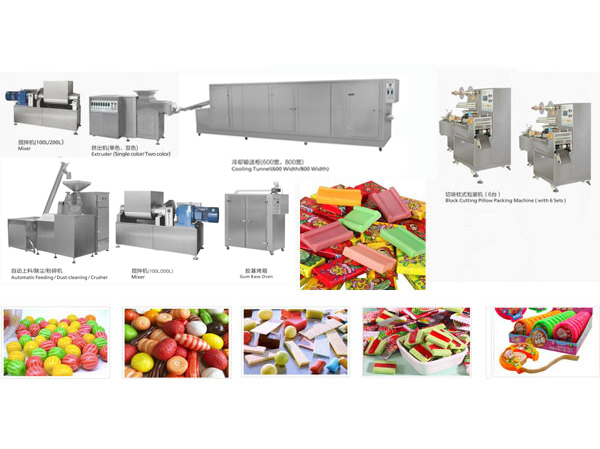
Factors Influencing the Selection of a Bubble Gum Production Line
- Bubble Gum Production Scale
Small-scale bubble gum production line: Suitable for startups or manufacturers with low production requirements, featuring low investment costs.
Medium-scale bubble gum production line: Suitable for medium-scale production, enhancing efficiency to meet market demand.
Large-scale bubble gum production line: Suitable for large-scale production, enabling automation and high-efficiency production. - Types of Bubble Gum: Select equipment with corresponding functions based on requirements such as bubble gum shape, flavor, and whether it contains a filling.
- Budget and Costs: Consider factors such as equipment investment, operational costs, and maintenance expenses to choose a cost-effective production line.
- Automation Level: Select semi-automatic or fully automatic production lines based on production needs and technical capabilities to enhance production efficiency and product quality.
- Supplier Services: Select reputable equipment suppliers that offer comprehensive after-sales service to ensure the stable operation of the production line.
By reasonably selecting and configuring bubble gum production lines, companies can improve production efficiency, ensure product quality, meet market demands, and maximize economic benefits.
Main Equipment of the Bubble Gum Production Line
The bubble gum production line is designed for efficient, automated production of bubble gum and primarily includes the following equipment and processes:
Main Equipment
- Raw Material Processing Equipment
Mixer: Blends gum base, sugar, glucose syrup, flavorings, and other raw materials to ensure uniformity.
Extruder: Extrudes the mixed raw materials into strips to prepare for subsequent shaping. - Molding Equipment
Molding Machine: Produces bubble gum in various shapes and sizes according to requirements, such as long strips, spheres, and irregular shapes.
Cooling Equipment: Rapidly cools the molded bubble gum to solidify and set its shape. - Packaging Equipment
Packaging Machine: Automatically measures, packages, and seals bubble gum to ensure product hygiene and aesthetics. - Auxiliary Equipment
Coating Machine (optional): Applies a sugar coating to bubble gum to enhance taste and appearance.
Dust Removal Equipment: Removes sugar powder and impurities generated during production.
The Process of Bubble Gum Production Line
- Ingredient Mixing and Blending: Raw materials such as gum base, sugar, glucose syrup, and flavorings are added to the mixer in specified proportions and thoroughly blended to ensure uniformity.
- Extrusion and Shaping: The blended raw materials are extruded into strips via an extruder. A shaping machine then cuts the strips into the desired length and shape.
- Cooling and Hardening: The formed bubble gum enters cooling equipment to rapidly cool and harden, maintaining its shape and texture.
- Packaging: The cooled bubble gum is automatically packaged by a packaging machine to ensure product quality and hygiene.
- Inspection and Storage: The packaged bubble gum undergoes quality inspection;合格 products are stored in inventory or shipped directly.
Energy Consumption of Bubble Gum Production Lines
The energy consumption of bubble gum production lines is mainly concentrated in the raw material processing, extrusion molding, cooling, and packaging stages. The following are the specific energy consumption details and energy-saving recommendations:
Energy Consumption Details
- Raw Material Processing Stage Main Equipment: Mixers, conveying equipment.
Energy Consumption Type: Electricity.
Energy Consumption Reasons: The mixing, heating, and conveying of raw materials require drive motors and heating systems, consuming a significant amount of electrical energy. - Extrusion Molding Stage
Main Equipment: Extruder, molding machine.
Energy Consumption Type: Electricity and thermal energy.
Energy Consumption Causes:
Electricity: The high-intensity mechanical operation of the extruder requires a large amount of electricity.
Thermal Energy: Maintaining the raw materials in a molten state requires continuous heating, consuming thermal energy.
- Cooling Stage Main Equipment: Cooling tunnel or cooling equipment.
Energy Consumption Type: Electricity and cooling water.
Energy Consumption Reasons:
Electricity: The cooling system requires electricity to drive fans or refrigeration equipment.
Cooling Water: A large amount of cooling water may be required to lower the product temperature. - Packaging stage
Main equipment: Packaging machines, sealing machines.
Energy consumption type: Electricity.
Energy consumption reasons: The operation of automated packaging equipment requires electricity to drive the machinery. - Auxiliary systems
Air compression systems, dust removal systems, lighting, and air conditioning, etc.:
Energy consumption type: Electricity.
Energy consumption reasons: Maintaining a clean and comfortable production environment and ensuring the normal operation of equipment.
Energy-saving measures for bubble gum production line
- Use of high-efficiency energy-saving equipment
High-efficiency motors: Use high-efficiency energy-saving motors to reduce power consumption.
Variable frequency drives: Apply variable frequency speed control technology to equipment such as extruders and packaging machines, adjusting operating speeds according to actual needs to minimize energy waste.
Energy-saving heating systems: Use high-efficiency heating elements and insulation materials to reduce heat loss. - Optimizing Production Processes
Precise Temperature Control: Optimize heating and cooling processes to avoid overheating or overcooling, thereby reducing energy consumption.
Continuous Production: Adopt continuous production processes to reduce the number of equipment starts and stops, thereby improving energy utilization efficiency. - Waste Heat Recovery
Heat Exchangers: Utilize heat exchangers to recover waste heat generated during extrusion and cooling processes, which can be used for preheating raw materials or heating water. - Energy Management System
Smart Monitoring: Install an energy management system to monitor energy consumption on production lines in real time, promptly identifying and addressing energy waste issues. - Optimized Production Planning
Optimize production scheduling: Avoid peak electricity pricing periods to reduce electricity costs.
Minimize equipment idle time: Optimize production processes to reduce equipment idle operation time.
By implementing the above energy-saving measures, bubble gum manufacturers can significantly reduce production line energy consumption, lower production costs, enhance economic and environmental benefits, and achieve sustainable development.
How to Precisely Control Temperature of Bubble Gum Production Line
Precise temperature control of a bubble gum production line is critical to ensuring product quality and production efficiency. The following are specific measures:
Key Temperature Control Points
- Raw Material Heating and Mixing
Temperature Range: The gum base must be heated to 45–60°C to soften, with the overall mixture temperature maintained below 60°C.
Control Points: Prevent overheating and aging of the gum base, and ensure thorough and uniform mixing of raw materials. - Extrusion Molding
Temperature Range: The extruder and die head temperatures are typically controlled between 50-55°C.
Control Points: Maintain good material flowability, avoid excessive temperatures causing deformation or insufficient temperatures leading to extrusion difficulties. - Cooling and Curing
Temperature Range: The cooling tunnel temperature is generally between 18-22°C, with humidity at 50-55%.
Key points: Rapid and uniform cooling to prevent product adhesion or deformation, ensuring hardness and texture.
Temperature Control Methods
- Advanced Temperature Control Equipment
High-precision temperature control system: Utilizes PLC or intelligent temperature controllers to achieve precise temperature setting and real-time monitoring, with control accuracy up to ±1°C.
Efficient heating and cooling elements: Uses electric heating rods, water cooling systems, etc., to rapidly respond to temperature changes. - Closed-loop feedback control Temperature sensors: Install high-sensitivity temperature sensors at critical locations to monitor temperature data in real time.
Automatic adjustment: The temperature control system automatically adjusts heating or cooling power based on feedback data to maintain stable temperature. - Segmented temperature control
Multi-segment temperature control for extruders: Independent temperature control is set for different heating zones to meet the requirements of gradual heating or cooling of materials.
Zone control for cooling tunnels: Different cooling zones and temperature parameters are set according to product characteristics. - Optimized thermal management system
Insulation measures: High-quality insulation materials are used on equipment and pipelines to reduce heat loss.
Waste Heat Recovery: Utilize waste heat to preheat raw materials or heat water, improving energy efficiency. - Process Parameter Optimization
Establish Standard Operating Procedures: Clearly define temperature, time, and other parameters for each stage, standardizing operational processes.
Real-Time Monitoring and Adjustment: Adjust temperature settings in real-time based on production conditions to ensure optimal process conditions. - Employee Training and Equipment Maintenance
Employee Training: Enhance temperature control training for operators to improve their understanding of the importance of temperature control and other operational procedures. - Waste Management: Collect and process waste generated during production.
- Equipment Cleaning and Maintenance: Regularly clean and maintain production equipment to ensure a hygienic production environment and normal equipment operation.
Through the above process flow, automated and efficient production of lollipops is achieved, ensuring product quality and production safety.