
Candy production line
candy production line is an automated or semi-automated equipment system used for large-scale production of various types of candy.
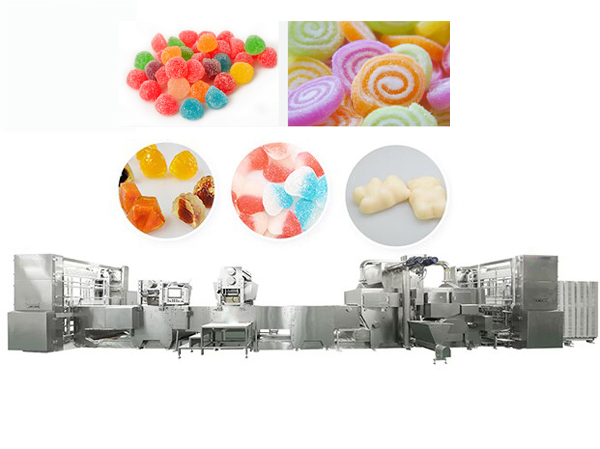
Detailed Introduction to the Candy Production Line
Basic Components
- Raw Material Processing Equipment
Mixer: Mixes sugar, water, starch syrup, and other raw materials to prepare syrup.
Sugar Melting Pot: Heats and dissolves sugar to form a uniform sugar solution. - Boiling and Concentration Equipment
Continuous Vacuum Boiling Machine: Boils syrup under vacuum conditions to control moisture content and temperature, preventing sugar crystallization. - Molding Equipment
Pouring Molding Machine: Suitable for hard candies, soft candies, etc., injecting the cooked syrup into molds to form shapes.
Pressing Molding Machine: Used for milk candies, tablet candies, etc., pressing the sugar mixture into specific shapes through stamping.
Stretching Machine: Used for producing pulled sugar, chewing gum, etc., repeatedly stretching the sugar mixture to achieve the desired texture. - Cooling and Curing Equipment
Cooling Tunnel: Rapidly cools and cures candies in a low-temperature environment.
Cooling Conveyor: Conveys candies to ensure uniform cooling. - Packaging Equipment
Automatic Packaging Machine: Completes candy metering, packaging, and sealing processes.
Labeling Machine: Applies labels to candy packaging to indicate product information.
Candy Production Line Process
- Raw Material Preparation and Mixing: Accurately measure sugar, water, starch syrup, food coloring, flavorings, and other raw materials according to the formula.
Thoroughly mix in a mixer to prepare syrup that meets the required specifications. - Boiling and Concentration: Heat the syrup to a certain temperature, boil under vacuum to remove excess moisture, and achieve the desired concentration.
- Cooling and blending: Cool the boiled syrup to an appropriate temperature, then add acidulants, spices, etc., for blending.
- Molding: Select the appropriate molding equipment based on the type of candy:
Hard candy: Pour into molds and cool to solidify.
Soft candy: Pour onto a cooling belt, then cut into shape after cooling.
Milk candy: Formed using a press molding machine.
Lollipops: Pour into molds while inserting sticks, then cool and shape. - Cooling and sorting: Send the shaped candies into a cooling tunnel or cooling conveyor to fully harden. Defective products are sorted out manually or by automatic equipment.
- Packaging: Use automatic packaging machines for inner packaging, such as bags or boxes.
Outer packaging may include cardboard boxes, labeling, etc., for convenient transportation and sales.
Common types of candy production line
- Hard candy production line: Uses sugar as the main ingredient to produce transparent or semi-transparent hard candy.
Process flow: Raw material mixing → Boiling → Cooling and blending → Molding → Cooling → Sorting → Packaging. - Soft Candy Production Line: Uses ingredients such as syrup, gelatin, or pectin to produce soft, pliable candies.
Process Flow: Raw material mixing → Boiling → Molding → Cooling → Cutting → Drying → Packaging. - Milk Candy Production Line: Uses sugar, milk powder, and cream as primary ingredients to produce smooth-textured milk candies.
Process flow: Raw material mixing → Boiling → Cooling and blending → Pressing and molding → Cooling → Sorting → Packaging. - Lollipop production line: Lollipops are produced by adding sticks to hard or soft candies.
Process flow: Raw material mixing → Boiling → Pouring and inserting sticks → Cooling and molding → Packaging. - Tablet Candy Production Line: Mix sugar powder with auxiliary materials and press into tablets to produce tablet candies.
Production Process: Raw material mixing → Tablet forming → Packaging.
Prices and investment of candy production line
- Small-scale candy production line
Price range: Approximately US$10,000–US$20,000.
Features: Suitable for start-ups or small-scale production, with simple equipment and low production capacity. - Medium-sized candy production line
Price range: Approximately $20,000–$50,000.
Features: Moderate production capacity, high degree of automation, capable of producing various types of candy. - Large-scale candy production line
Price range: Over $50,000, potentially reaching the million-dollar level.
Features: Highly automated, high production capacity, suitable for large-scale commercial production.
Maintenance and Management of Candy Production Lines
- Equipment Maintenance: Develop a maintenance plan and conduct regular equipment cleaning, lubrication, and inspections. Replace wear-and-tear parts in a timely manner to ensure normal equipment operation.
- Quality Control: Establish a comprehensive quality management system and conduct strict inspections of raw materials, production processes, and finished products. Ensure that the taste, color, and shape of the candy meet standards.
- Occupational Safety: Enhance employee safety training to improve safety awareness. Adhere to occupational safety procedures to prevent accidents.
Through scientific planning and management of the candy production line, companies can improve production efficiency, ensure product quality, meet market demand, and achieve sustainable development.
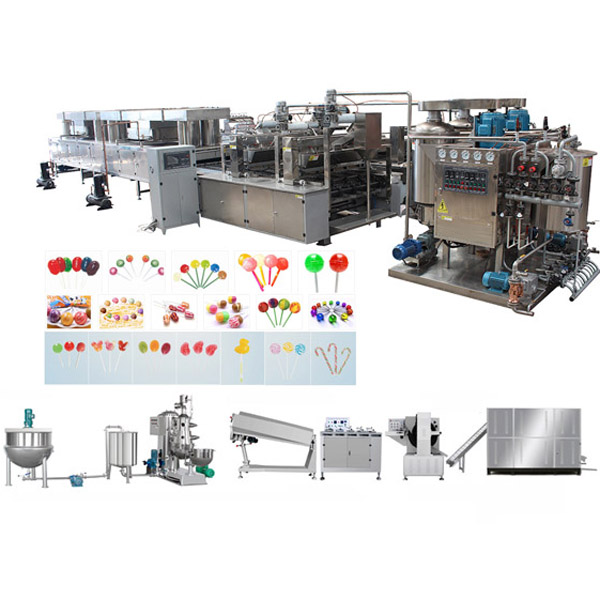
How to Choose Candy Production Line
When selecting the appropriate candy production line, the following key factors should be considered:
Product Type and Characteristics
Candy Types:
Hard Candy Production Line: Requires vacuum sugar boiling equipment and molding or pressing machines.
Gummy Production Line: Requires gelatin and pectin boiling equipment, molding, and drying equipment.
Milk Candy Production Line: Requires mixing boiling equipment and stamping molding machines.
Lollipop Production Line: Based on hard candy or soft candy equipment, adds a stick insertion device.
Tablet Candy: Requires tablet presses and packaging equipment.
Shape and Size: Determine the candy’s shape (e.g., spherical, square, irregular) and size range, and select equipment with corresponding molds or molding capabilities.
Candy production line scale and capacity requirements
Production volume requirements:
Small-scale candy production line (<100 kg/h): Choose small-scale, semi-automatic equipment with low investment costs, suitable for startups or small-scale enterprises. Medium-scale candy production line (100–500 kg/h): Choose medium-scale automated equipment to improve production efficiency and meet market demand. Large-scale candy production line (>500 kg/h): Select fully automated, high-speed production lines to achieve large-scale production and reduce unit costs.
Production Frequency: Consider whether production is continuous or intermittent, and focus on the stability and adaptability of the equipment when selecting it.
Budget and Investment Costs
Candy Processing Equipment Prices: Select cost-effective equipment within the budget range, while considering the brand, quality, and after-sales service of the equipment.
Operating costs: These include energy consumption, labor costs, maintenance expenses, etc. Choose energy-efficient, environmentally friendly, easy-to-operate equipment with low maintenance costs.
Automation level and technical requirements
Automation level of candy production lines:
Semi-automatic candy production lines: Suitable for businesses with limited budgets or those requiring flexible adjustments.
Fully automatic candy production lines: Improve production efficiency, reduce labor costs, and suitable for large-scale production.
Technical Capabilities: Assess your own technical team and operational capabilities, and choose equipment that is easy to operate and maintain, or suppliers that provide comprehensive training and support.
Raw Material and Formula Adaptability
Raw Material Characteristics: Ensure the equipment can handle the required raw materials, such as high-temperature boiling or mixing of special additives.
Formula Flexibility: If frequent formula adjustments are needed, choose equipment with a flexible control system and convenient adjustment capabilities.
Space and Site Requirements
Factory Area: Based on equipment dimensions and layout, ensure sufficient space for installation and operation.
Infrastructure: Consider whether power supply, water supply, drainage, ventilation, and other infrastructure meet equipment requirements.
Supplier Selection and After-Sales Service
Supplier Reputation: Select experienced, reputable equipment suppliers that provide reliable equipment and quality service.
After-Sales Service: Pay attention to the supplier’s after-sales service, including equipment installation and commissioning, training, maintenance, and repairs.
Compliance with Regulations and Standards
Food Safety Standards: Ensure that the equipment complies with national and regional food safety regulations and standards, such as material hygiene and operational procedures.
Certification Requirements: The equipment should have relevant certifications, such as CE and ISO, to ensure quality and safety.
Future Development Needs
Scalability: Consider future product upgrades or production capacity expansion needs, and choose scalable or modular equipment.
Technological Innovation: Pay attention to new technologies and development trends in the industry, and choose equipment with upgrade potential.
Summary: When selecting a candy production line, comprehensively consider factors such as product type, production scale, budget, automation level, raw material adaptability, space requirements, supplier services, and regulatory standards. It is recommended to conduct on-site visits to multiple suppliers to understand equipment performance and services, and develop a detailed procurement plan to ensure the selected equipment meets current and future production needs.
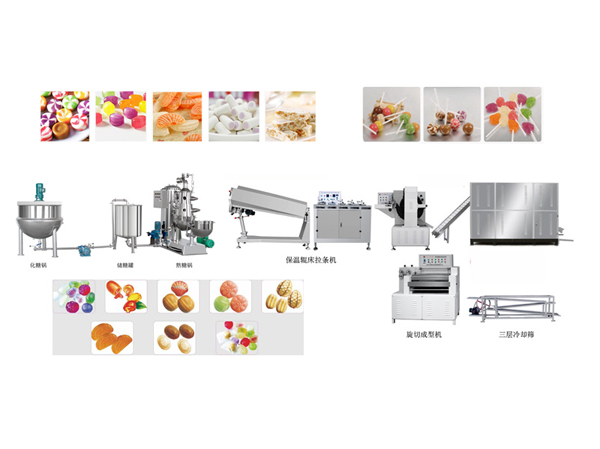
What is energy consumption of candy production line?
The energy consumption of a candy production line is mainly concentrated in the raw material processing, boiling and concentration, molding, cooling and drying, and packaging stages. The following is a detailed breakdown of energy consumption and common energy-saving equipment:
Energy consumption of a candy production line
- Raw material processing stage
Energy-consuming equipment: mixers, conveyor belts, washing machines, etc.
Energy consumption ratio: Mixers account for approximately 30%, conveyor belts approximately 15%, and washing machines approximately 18%.
Energy consumption reasons: The processes of raw material mixing, conveying, and washing require a significant amount of electricity. - Boiling and concentration stage
Energy-consuming equipment: Sugar boiling pots, steam boilers, etc.
Energy consumption ratio: Accounts for 30%-40% of total energy consumption.
Energy consumption reasons: High-temperature boiling of syrup requires a large amount of thermal energy, primarily consumed by steam or fuel. - Candy Molding Process
Energy-consuming equipment: Pouring molding machines, stamping molding machines, etc.
Energy consumption ratio: Approximately 10%-15% of total energy consumption.
Energy consumption reasons: Equipment operation and maintaining molding temperatures require electricity and thermal energy. - Cooling and drying process
Energy-consuming equipment: Cooling tunnels, drying equipment, etc.
Energy consumption ratio: Approximately 15% of total energy consumption.
Energy consumption reasons: The cooling and drying processes consume a large amount of electricity and thermal energy. - Packaging process
Energy-consuming equipment: Automatic packaging machines, labeling machines, etc.
Energy consumption ratio: Approximately 10% of total energy consumption.
Energy consumption reasons: The operation of packaging equipment requires electricity.
Energy-saving equipment for candy production lines
- High-efficiency energy-saving boiling equipment
Continuous vacuum boiling machine: Boils under vacuum conditions, reducing boiling temperature and time to save energy.
High-efficiency energy-saving steam boiler: Uses advanced combustion technology to improve fuel utilization and reduce fuel consumption. - Energy-saving forming equipment
Servo-controlled forming machine: Uses a servo control system to precisely control the forming process, reducing energy waste.
Low-temperature forming equipment: Reduces forming temperature, minimizing thermal energy consumption. - Waste Heat Recovery Equipment
Heat Exchanger: Recovers waste heat generated during boiling and drying processes for preheating raw materials or heating water.
Waste Heat Recovery System: Recovers heat from exhaust gases for reuse, improving energy utilization efficiency. - High-efficiency cooling equipment
High-efficiency cooling tunnel: Uses an optimized cooling system and high-efficiency fans to improve cooling efficiency and save energy.
Chiller unit: Uses high-efficiency compressors and heat exchangers to reduce cooling energy consumption. - Energy-saving packaging equipment
Variable-frequency drive packaging machine: Uses variable-frequency speed control technology to adjust operating speed according to actual needs, reducing power consumption.
Energy-saving labeling machine: Optimizes the labeling process to reduce energy waste. - Intelligent control systems
Energy management systems: Real-time monitoring of energy consumption on production lines, optimizing energy allocation, and improving energy efficiency.
Automated control systems: Achieving automated control of production processes, reducing manual intervention, and improving production efficiency and energy utilization rates.
By adopting the aforementioned energy-saving equipment and optimizing production processes, candy manufacturers can significantly reduce energy consumption, lower production costs, enhance economic and environmental benefits, and promote sustainable development of the enterprise.
How to Develop Maintenance Plan for Candy Production Line
Developing a maintenance plan is crucial for ensuring stable equipment operation, extending service life, and reducing maintenance costs. The following are detailed steps:
I. Define Maintenance Objectives and Conduct Equipment Analysis
- Set Maintenance Objectives
Quantify objectives: Reduce failure rate (e.g., by 30%), extend equipment lifespan (e.g., increase MTBF by 20%), and control maintenance costs (e.g., within 5% of the equipment’s total value).
Equipment classification: Categorize equipment into critical, important, and general equipment based on importance, and develop different maintenance strategies accordingly. - Collect and Analyze Equipment Information
Establish equipment records: Document equipment model, serial number, years of use, and historical faults.
Failure mode analysis: Use methods such as fault tree analysis (FTA) to identify high-frequency fault points and causes. II. Developing Maintenance Strategies and Cycles - Selecting Maintenance Strategies
Preventive maintenance: Regular maintenance, such as cleaning, lubrication, and replacement of wear parts, suitable for most equipment.
Predictive maintenance: Utilizing monitoring data to predict equipment status and take proactive measures, suitable for critical equipment.
Corrective maintenance: Maintenance after equipment failure, aiming to minimize downtime. - Determine Maintenance Cycles
Time-based method: Based on equipment operating time, such as maintenance every 500 hours.
Performance degradation method: Based on equipment performance parameters, such as maintenance when accuracy drops below a certain threshold.
Dynamic adjustment: Flexibly adjust maintenance cycles based on production schedules, seasonal changes, and actual equipment conditions.
III. Refine Maintenance Content and Resource Allocation
- Develop a maintenance task list
Daily maintenance: Clean equipment, inspect fasteners, lubricate moving parts, etc.
Scheduled maintenance: Deep cleaning, functional testing, replacing worn parts, calibrating accuracy, etc. - Resource allocation
Staff training: Train operators and maintenance personnel to master equipment operation, daily maintenance, and fault handling skills.
Spare parts management: Establish a reasonable spare parts inventory to ensure adequate stock of commonly used parts and reduce downtime waiting time.
Tools and Equipment: Provide necessary maintenance tools and testing equipment, such as lubrication tools and measuring instruments.
IV. Implementation Monitoring and Continuous Improvement
- Data Recording and Analysis
Record maintenance data: Detailed records of the time, content, personnel, and costs of each maintenance task.
Indicator Monitoring: Track equipment failure rates, mean time to repair (MTTR), overall equipment effectiveness (OEE), and other indicators. - Continuous Improvement
PDCA Cycle: Follow the Plan-Do-Check-Act (PDCA) cycle to continuously optimize maintenance plans.
Case Analysis: Analyze typical failure cases, summarize lessons learned, and improve maintenance measures. - Establish Emergency Response Plans
- Develop Emergency Measures: Develop emergency response plans for potential failures of critical equipment, clearly defining handling procedures and responsible parties.
- Backup Equipment and Alternatives: Prepare backup equipment or temporary alternatives to ensure production is not significantly impacted in the event of equipment failure.
Six. Summary
By following the above steps, a scientifically sound and reasonable equipment maintenance plan can be established to effectively enhance equipment reliability and service life, reduce maintenance costs, and ensure smooth production operations. Additionally, continuously improving and optimizing maintenance strategies to adapt to changes in equipment operating environments and production requirements can enhance the company’s competitiveness.