
Hard candy machine
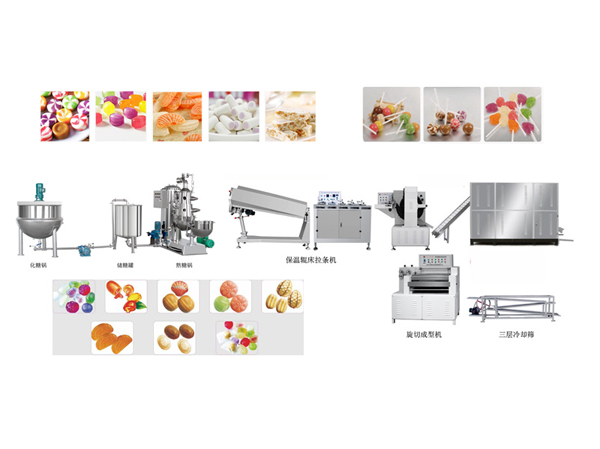
Hard candy making machine is special equipment used for producing hard candy, mainly including the following types: sugar boiling equipment,hard candy moulding machine,hard candy packing machine
- Sugar Simmering Equipment
Function of Vacuum Film Sugar Simmering Machine: rapidly concentrate the sugar liquid under vacuum condition, prevent the sugar from caramelisation and improve the quality of sugar paste.
Features: even heating, high evaporation efficiency, suitable for high quality hard sugar production. - Forming equipment
Function of stamping moulding machine: stamp the cooled sugar bars into the required hard candy shape.
Characteristics: high production efficiency, suitable for mass production, and can produce various shapes of hard candies.
Function of pouring moulding machine: inject the boiled sugar paste quantitatively into the mould, and then shape it after cooling.
Characteristics: Suitable for producing shaped hard candies or sandwich hard candies with various shapes. - Auxiliary equipment
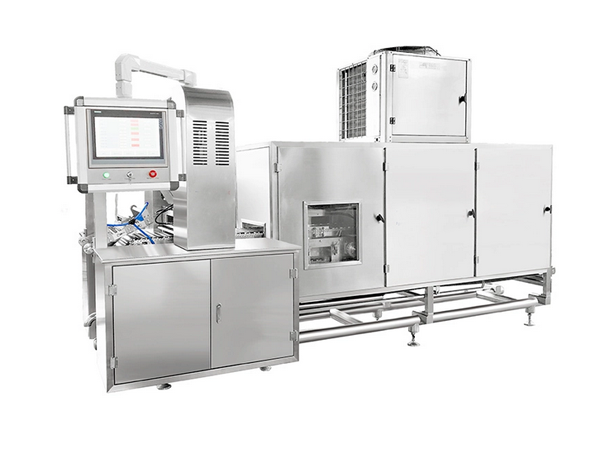
Function of cooling conveyor belt: cool the hard candy after moulding to make it harden and set the shape.
Packing machine function: to pack the finished hard candies to ensure the hygiene and beauty of the products.
Function of Sugar Stick Machine: Make the boiled sugar paste into uniform sugar sticks, prepare for stamping and moulding.
Processing technology of hard candy production line
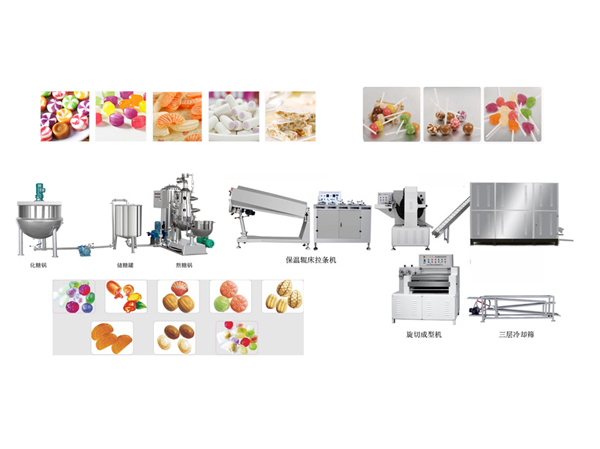
The production process of hard candy processing machine mainly includes the following steps:
- Raw material preparation and dosing
Raw material selection: the main raw materials include sugar, starch syrup, water, and auxiliary materials such as acidifier, flavouring, colouring and so on added according to the needs.
Calculation of ingredients: According to the product formula, calculate the dosage of each ingredient accurately to ensure the balance of dry solids and reducing sugar. - Sugar chemistry
Adding water and dissolving: Mix white granulated sugar with appropriate amount of water (generally 30%~35% of the total amount of dry solids), heat it up to 105~110℃, and stir it to make the granulated sugar dissolve completely.
Add syrup and auxiliary materials: after the granulated sugar is dissolved, add starch syrup and other auxiliary materials, continue heating and keep boiling for 2~3 minutes.
Filtering: Filter the sugar solution through a 100-mesh sieve to remove impurities and ensure the sugar solution is clear and transparent. - Sugar boiling
Vacuum boiling: pump the filtered sugar solution into the vacuum boiling machine, heat and concentrate under vacuum condition, control the temperature at 145~150℃, so that the concentration of sugar solution reaches the required hardness.
Monitor the state of sugar paste: Ensure that the sugar boiling process meets the requirements by detecting the water content and reducing sugar content of the sugar paste. - Cooling and blending
Cooling: Convey the boiled sugar paste to the cooling table or cooling conveyor belt to reduce its temperature gradually.
Blending: When the sugar paste is cooled down to a suitable temperature, add acidifier, flavouring agent, colouring agent, etc., and mix well to ensure the consistent flavour and colour. - Forming
Press moulding
Sugar bar preparation: The blended sugar paste is passed through the sugar bar machine to form uniform sugar bars.
Stamping: Use the stamping moulding machine to stamp the sugar bars into the desired hard candy shape.
Pouring
Sugar Paste Pouring: Sugar paste is quantitatively injected into the forming moulds to form hard candies after cooling.
Demoulding: After the hard candy is solidified, it is removed from the mould. - Cooling and Hardening
Cooling: Place the moulded hard candy in a cooling conveyor belt or cooling chamber and continue to cool to room temperature to harden completely.
Hardening: If required, hard candies are put into the hardening room for further processing to ensure hardness and stability. - Selection and Packaging
Selection: Quality check the finished hard candies and reject the unqualified products.
Packing: Use the packing machine to pack the qualified hard candies to ensure the products are hygienic and beautiful. - Finished product inspection and storage
Quality Inspection: Sampling and testing of packed hard candies to ensure compliance with quality standards.
Storage: The qualified finished products will be put into storage and stored in a dry and cool environment to prevent moisture and deterioration.
Through the above process, the hard candy processing machine can produce high quality hard candy products efficiently and stably.
Common Problems in Hard Candy Production
In hard sugar production, common quality problems mainly include the following categories:
- Melting and sanding
Melting: hard sugar becomes soft and sticky after absorbing moisture, and loses brittleness.
The main reasons are:
Reduced sugar content is too high: the proportion of fructose, inverted sugar and other reducing sugars in the ingredients is too high, which increases the moisture absorption.
Insufficient boiling temperature: the water content of the sugar solution is too high, resulting in easy moisture absorption of the finished product.
High environmental humidity: the humidity of the production or storage environment is too high, and the hard sugar absorbs moisture from the air.
Sanding: Sucrose crystals appear inside the hard sugar, the surface is rough and the taste deteriorates. The main reasons are:
Reduced sugar content is too low: not enough to inhibit the crystallisation of sucrose.
Cooling is too fast or uneven: nuclei are formed during the cooling process of the sugar paste, prompting crystallisation.
Existence of crystal seeds: residual sucrose crystals in the raw material or impurities introduced during the production process. - Surface quality problems
Surface unevenness:
Mould problem: Mould design is unreasonable or surface is rough, resulting in uneven forming of candy.
Improper operation: external impact during cooling process or improper temperature control of sugar paste.
Uneven colour:
Uneven colouring: inaccurate amount of pigment added or uneven mixing.
Raw material contamination: contact with coloured impurities during the production process. - Taste and Flavour Problems
Poor taste:
Unreasonable recipe: improper proportion of sugar, acid and spices, affecting the taste.
Excessive boiling of sugar: too high temperature or too long time, the sugar liquid is scorched and the taste becomes bitter.
The flavour is not prominent:
Flavour quality problem: poor quality of flavour or insufficient addition.
Improper process: volatilisation or destruction of flavour substances during heating. - Physical structure problems
Bubbles: The air bubbles are not eliminated during the cooling process of sugar paste, resulting in voids inside or on the surface of the finished product.
Cracking: Sugar paste is cooled too fast or too hard, cracks appear when moulding.
Deformation: deformation under pressure during storage or transport, especially for soft hard candies.
- Hygiene and impurity problems
Excessive microorganisms: the production environment is not hygienic and the equipment is not thoroughly cleaned, leading to bacterial and mould contamination.
Impurities mixed in: raw materials are not strictly screened, and foreign materials are introduced during the production process, such as paper scraps and twine. - Packaging problems
Inadequate packaging: poor sealing, leading to moisture or contamination of hard candies.
Unqualified packaging materials: poor quality of materials, affecting the shelf life of the product.
In view of the above problems, manufacturers should strengthen the quality control of raw materials, optimise the parameters of the production process, standardise the operation procedures, regularly maintain the equipment, improve the production environment, and strictly implement the quality inspection system to ensure the quality and safety of hard candy products.