
Chocolate candy making machine
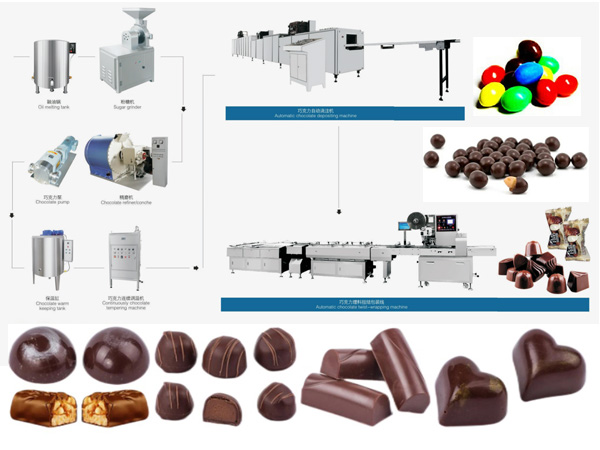
Chocolate candy making machines are specialised machines for the production of chocolate, covering the entire process from raw material handling to packaging of the finished product. The main Chocolate making machines include:
- Raw material pre-processing equipment
Grinders: to grind cocoa beans, sugar and other raw materials into a fine powder to ensure a homogeneous mix.
Mixers: used to accurately proportion and mix the various ingredients to form the chocolate base. - Refining equipment
Refiner: removes undesirable flavours from raw materials through mechanical friction and heating, enhancing the taste and texture of chocolate. Newer equipment is more energy efficient and requires less maintenance. - Tempering equipment
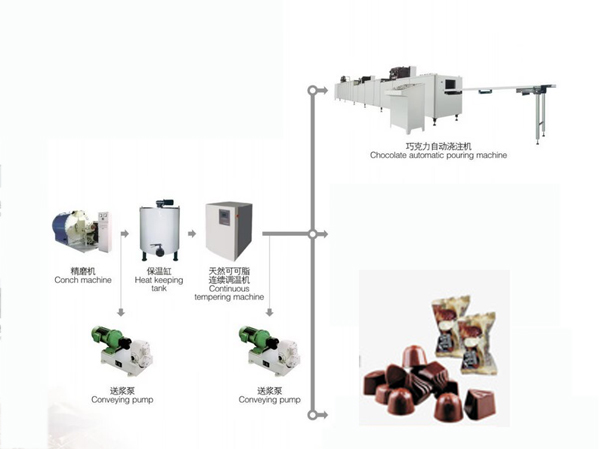
Tempering machines: control the temperature of the chocolate to ensure that it crystallises correctly and develops a smooth appearance and good taste. Advanced thermoregulation equipment can precisely control the temperature profile. - Forming equipment
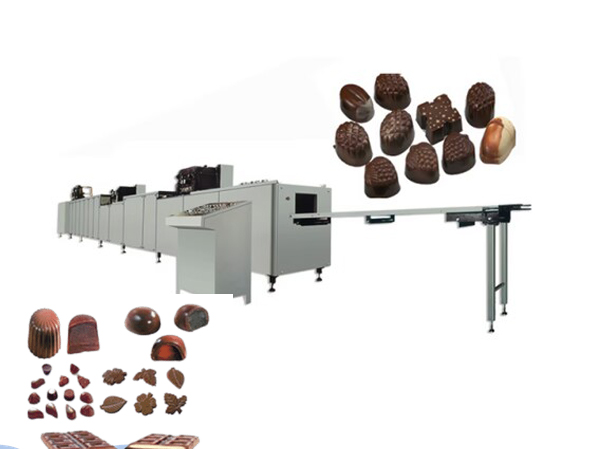
Chocolate pouring moulding machine: inject liquid chocolate into moulds and form various shapes of chocolate, such as block, sphere, egg shape, etc. after cooling.
Chocolate Extrusion Moulding Machine: Extrude the chocolate material by extruding, suitable for producing chocolate in the shape of long bar, flake and so on.
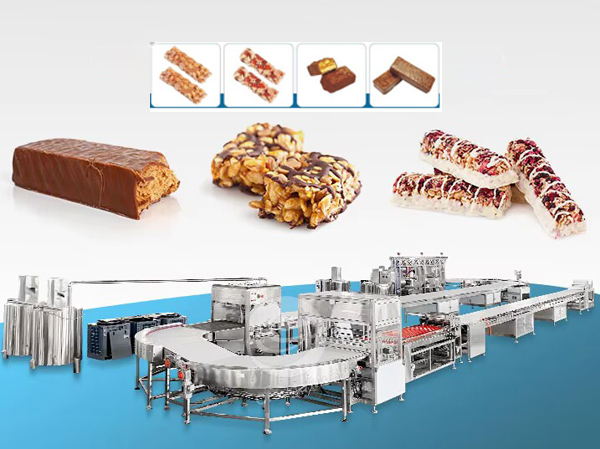
Chocolate Coating Machine: Coating chocolate layer on the surface of biscuits, wafers and other foodstuffs to produce composite chocolate products. - Packaging equipment
Automatic packaging machine: for packaging finished chocolate products, including individual and combined packaging, to ensure product hygiene and aesthetics.
Secondary packaging equipment: used to combine small packages of chocolate into gift boxes or large packages to improve the added value of the product. - Auxiliary equipment
Cooling tunnels: used to quickly cool the moulded chocolate to harden and set the shape.
Conveying system: conveying chocolates between processes to achieve continuity and automation of the production process.
Provide a complete chocolate production line from raw material processing to finished product packaging, with stable equipment performance and strong technological innovation.
Equipment performance: focus on stability, automation, energy efficiency and hygienic design to ensure production efficiency and product quality.
After-sales service: choose a supplier with good after-sales service and technical support to ensure the normal operation and maintenance of the equipment.
Through the reasonable configuration of Chocolate making machines, enterprises can improve production efficiency, ensure product quality and meet the diversified needs of the market.
Chocolate production process
The chocolate production process consists of the following steps:
- Harvesting and pre-treatment of cocoa beans
Harvesting the cocoa nibs: manually picking the ripe cocoa nibs.
Removal of the cocoa beans: the pods are opened and the cocoa beans wrapped in the pulp are removed.
Fermentation: The cocoa beans are stacked with the pulp or placed in a fermenter for 5-7 days to reduce acidity and enhance flavour.
Drying and storage
Drying: Dry the fermented cocoa beans in the sun or use drying equipment to reduce the moisture content to around 7%.
Storage: Dry cocoa beans are put into sacks and stored in ventilated, dry warehouses. - Processing of cocoa beans
Roasting: Roast cocoa beans at 110-130°C for about 30-60 minutes to release aroma and adjust flavour.
Dehulling: Remove the shell of the cocoa beans to obtain cocoa nibs.
Crushing: crushing the nibs into smaller particles. 3. - Preparation of cocoa pulp and cocoa powder
Coarse grinding: Grinding of the cocoa nibs into cocoa liquor, where the cocoa butter is released.
Fine grinding: further grinding of the cocoa pulp to form a fine paste.
Pressing: Separation of the cocoa butter from the cocoa mass and the cocoa cake using a hydraulic press.
Crushing: the cocoa cake is crushed to make cocoa powder. - Chocolate preparation and refining
Mixing: mixes the cocoa paste, cocoa butter, sugar, milk powder (milk chocolate) and other ingredients in proportion to the type of product.
Mixing: thorough stirring to ensure that the ingredients are evenly distributed.
Refining: stirring for a long time under high temperature (24-72 hours) to remove impurities, enhance the taste and make the chocolate delicate and smooth. - Tempering and moulding
Rising temperature: heat the chocolate to 45-50℃ to melt the cocoa butter.
Cooling down: cool down to 27-28°C to encourage the cocoa butter to form a stable crystal structure.
Tempering: Reheat to 31-32°C to remove unstable crystals.
Pouring: the tempered chocolate is injected into the mould.
Cooling: rapid cooling in the cooling tunnel to solidify the chocolate into moulds.
Demoulding: remove the chocolate from the mould. - Packaging and storage
Packaging: the chocolates are packaged using aluminium foil, plastic wrapping or gift boxes to protect them from moisture, oxidation and contamination.
Storage conditions: store in a cool, dry and light-proof environment, with the temperature controlled at 15-18°C and humidity not exceeding 50%.
Through the above steps, the cocoa beans undergo a complex processing, and finally made into delicious chocolate. Each step needs to be strictly controlled to ensure the quality and taste of chocolate.
How to Temperature Control Chocolate
Controlling the crystalline structure of chocolate during the tempering process is the key to making high quality chocolate and is achieved by the following steps and methods:
- Temperature control
Warming-up phase
Heating and melting: heating the chocolate to a specific temperature over water:
Dark chocolate: 45-50°C
Milk chocolate: 40-45°C
White chocolate: 40-45°C
Purpose: melting all the cocoa butter crystals and eliminating the unstable structure of the original.
Cooling down stage
Cooling down: mix the partially melted chocolate with the unmelted chocolate (seed method) or cool it down using marble slabs, ice water, etc.:
Dark chocolate: 27-28°C
Milk chocolate: 26-27°C
White chocolate: 26-27°C
Purpose: to induce the formation of stable V-type crystals (β-forms) of the cocoa butter, which give the chocolate its ideal shine and texture.
Tempering phase Tempering again: bringing the chocolate to the working temperature
Dark chocolate: 31-32°C
Milk chocolate: 29-30°C
White chocolate: 28-29°C
Purpose: to melt unstable crystals, retain stable V-shaped crystals and ensure a homogeneous texture of the chocolate. - Stirring
Continuous stirring: Stir the chocolates continuously throughout the tempering process.
Function: Promote the even transfer of heat and prevent localised overheating or overcooling.
It helps to transform unstable crystals into stable crystals, forming a homogeneous crystal network. - Time control
Cooling time: Give sufficient time for the cocoa butter crystals to form a stable network structure.
Avoid rapid cooling: rapid cooling can lead to the formation of unstable crystals and affect the quality of the chocolate. - Use of the seed method
Method: Mix part of the melted chocolate (2/3) with the unmelted chocolate (1/3).
Principle: The unmelted chocolate acts as a ‘seed’, providing a stable nucleus that guides the other cocoa butter crystals. - Avoid contact with moisture.
Caution: The chocolate should never come into contact with moisture during the tempering process.
Reason: Moisture can cause the chocolate to clump together, destroying the crystal structure and affecting the flavour and texture. - Tools and ring
Tools:
Use specialised tools such as accurate food thermometers, marble slabs, tempering spatulas, etc.
Environment:
Operate under suitable temperature and humidity
Temperature: 18-22℃
Humidity: 45-55 - Judging the success of tempering
Method: Spread a small amount of tempered chocolate on the spatula and leave it for 5 minutes.
Signs of success: The chocolate solidifies quickly and the surface is smooth and shiny.
Signs of failure: The chocolate does not solidify for a long time, or the surface is white (white cream) after solidification.
The above methods can effectively control the crystal structure of the chocolate during tempering, and produce high quality chocolate with a shiny appearance, crispy texture and melt-in-your-mouth quality.
y.
Types of chocolate
There is a wide variety of chocolates, which can be categorised mainly according to their composition, cocoa content, additives and production process:
Classification by composition
Characteristics of dark chocolate: high cocoa solids content (usually over 70%), low sugar content, rich and slightly bitter taste. It is rich in antioxidants, which are beneficial for cardiovascular health.
Characteristics of milk chocolate: added milk or dairy products, cocoa solids content is lower (about 25% – 50%), sweet and smooth taste.
Characteristics of white chocolate: does not contain cocoa powder, only made from cocoa butter, sugar and milk, creamy colour, sweet taste. Because it does not contain cocoa powder, some people do not think it belongs to the real chocolate.
Classified by cocoa content
Extra Amer Cocoa content: about 85% or more. It has a strong bitter flavour and is suitable for chocolate lovers.
Bitter chocolate (Amer) Cocoa content: 75%-85%. Bittersweet chocolate has a distinctly bitter flavour with a slight sweetness.
Bittersweet cocoa content: about 35%. It has a balanced sweet-bitter flavour and is suitable for the general public.
Classification by additives
Characteristics of sandwich chocolate: chocolate shell wrapped with a variety of fillings, such as nuts, jams, wine hearts, etc.
Characteristics of nut chocolate: adding walnuts, almonds and other nuts, rich in taste and more comprehensive nutrition.
Characteristics of flavoured chocolates: spices, dried fruits, alcohol, etc. are added to give the chocolate a unique flavour.
For example, matcha chocolate, orange peel chocolate, rum chocolate.
Classification by production process
Characteristics of raw chocolate: high water content, soft texture, delicate taste, short shelf life.
Characteristics: handmade by chocolatiers, exquisite modelling, unique taste, higher price.
Features of industrialised chocolate: mass production, stable taste, relatively affordable.
Other special types
Characteristics of cocoa butter substitute chocolate: using cocoa butter substitute to replace part or all of the cocoa butter, low cost, but the taste and nutritional value is not as good as pure cocoa butter chocolate.
Characteristics of organic chocolate: made from organic cocoa beans without chemical additives, in line with the concept of environmental protection and health.
The above is a brief introduction to the types of chocolate, consumers can choose the right chocolate for themselves according to their personal taste and needs.