
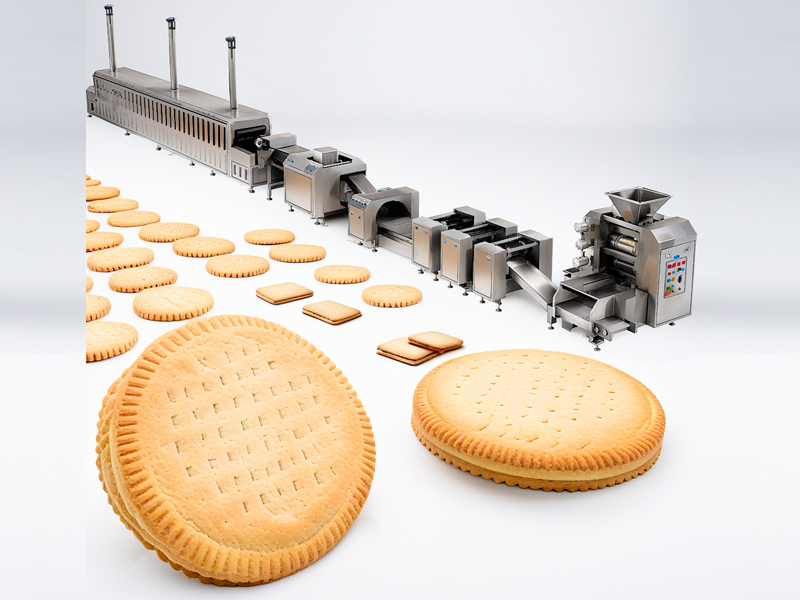
Difference Between Crispy Biscuit Making Equipment and Chewy Biscuit Equipment
Shortbread biscuit equipment and chewy biscuit equipment are used in biscuit production to process different types of dough. Their main differences are as follows:
Dough Characteristics
Shortbread biscuit Equipment: Processes high-fat, low-moisture shortbread dough. The dough is soft and easy to shape, resulting in a crispy texture.
Chewy biscuit Equipment: Processes low-fat, high-moisture chewy dough. The dough has a certain degree of elasticity and resilience, resulting in a harder texture.
Forming Methods
Shortbread biscuit equipment: Typically uses roller-imprint forming or die-cutting forming. The dough is formed in one step, producing biscuits with clear patterns and diverse shapes.
Chewy biscuit equipment: Uses multiple roller calendering and cutting forming. The dough is rolled thin through multiple rollers before being cut into the desired shapes.
Equipment Structure
Shortbread biscuit equipment: Simple structure, primarily consisting of a flour mixer, forming machine, and baking equipment. The forming section typically includes mold rollers and printing devices.
Resilient biscuit equipment: Relatively complex structure, including a flour mixer, forming machine, and waste material recovery system. The forming section features multiple rolling pins and mold rolls to ensure uniform thinning of the dough.
biscuit Equipment Process Flow
Crispy biscuit equipment: Process flow: flour mixing → forming → baking → cooling → packaging. When mixing the dough, fats, sugar, and water are first emulsified, then flour is added.
Chewy biscuit equipment: Process flow: dough mixing → rolling → forming → baking → cooling → packaging. The dough requires thorough mixing and rolling to form a gluten structure.
Product Features
Shortbread biscuit Equipment: The biscuits produced are crispy and delicate, such as biscuits and almond biscuits. The biscuit surfaces have clear patterns and a rich texture.
Chewy biscuit Equipment: The biscuits produced have a firm and resilient texture and are less prone to breaking, such as soda biscuits and chewy biscuits. The biscuits have a slightly chewy texture and are suitable for long-term storage.
Application Scenarios
Crispy biscuit Equipment: Suitable for producing high-quality, diverse crispy biscuits, commonly used in small to medium-sized bakeries or food processing plants.
Chewy biscuit equipment: Suitable for large-scale production of standardized chewy biscuits, suitable for large-scale food production enterprises.
By understanding the above differences, you can select the appropriate biscuit production equipment based on product requirements to improve production efficiency and product quality.
Prices of crispy biscuit making equipment and chewy biscuit machine
The prices of chewy biscuit machines and crispy biscuit machines vary depending on factors such as equipment model, production capacity, automation level, and manufacturer. Below are the price ranges and influencing factors for both:
Chewy biscuit machine prices
Small-scale chewy biscuit equipment:
Price range: Approximately 40,000–90,000 RMB.
Features: Suitable for startups or small-scale production, with lower production capacity and moderate automation levels.
Medium-sized chewy biscuit equipment:
Price range: Approximately 90,000–200,000 RMB.
Features: Moderate production capacity with some automation capabilities, suitable for medium-scale production needs.
Large-scale resilient biscuit equipment:
Price range: Over 200,000 RMB, and can even reach over 800,000 RMB.
Features: High production capacity, fully automated production lines, suitable for large-scale food production enterprises, enabling efficient and continuous production.
Crispy biscuit Machine Prices
Small-scale crispy biscuit equipment:
Price range: Approximately 40,000–80,000 RMB.
Features: Suitable for producing various types of crispy biscuits, such as biscuits and peach biscuits, with relatively small production capacity and simple operation.
Medium-sized crispy biscuit equipment: Price range: Approximately 80,000–180,000 RMB.
Features: Enhanced production capacity, good automation level, suitable for small and medium-sized enterprises looking to expand production scale.
Large-scale crispy biscuit equipment:
Price range: Over 180,000 RMB, with high-end equipment potentially exceeding 800,000 RMB.
Features: High production capacity, fully automated, suitable for large-scale production, equipped with advanced control systems and multi-functional forming equipment.
Factors affecting price
Production capacity: The higher the equipment’s production capacity, the higher the price.
Automation level: Fully automated equipment is more expensive than semi-automated equipment but improves production efficiency and product quality.
Equipment configuration: The types of molds, baking systems, cooling systems, and other configurations can affect the price.
Brand and manufacturer: Well-known brand equipment is typically more expensive but offers better quality and after-sales service.
Materials and manufacturing processes: The materials used and manufacturing processes also influence the price; equipment made with high-quality materials and advanced processes is more durable.
Purchase Recommendations
Clarify Requirements: Select the appropriate equipment model and configuration based on your production scale and product type.
Compare Multiple Suppliers:
Request quotes from multiple suppliers to understand the performance and prices of different brands and models.
Consider After-Sales Service:
Choose manufacturers that offer good after-sales service and technical support to ensure the equipment operates normally.
Budget Planning: Take into account equipment costs, transportation, installation, maintenance, and other expenses to establish a reasonable budget.
With the above information, you can better understand the price range and influencing factors of resilient biscuit machines and crispy biscuit machines, enabling you to make a more informed purchasing decision.
What should be considered when purchasing biscuit making machine machine
When purchasing equipment, the following key parameters should be considered:
Basic performance parameters
Processor:
Type and model: such as the CPU series and specific model, which affect the device’s computational capability.
Number of cores and clock speed: the more cores and the higher the clock speed, the stronger the device’s ability to handle multitasking and complex computations.
Memory:
Capacity: determines how many programs the device can run simultaneously; the larger the better.
Type and Speed: Such as DDR4 or DDR5; faster speeds result in higher data transfer efficiency.
Storage:
Capacity: The space for storing files and applications; choose based on your needs.
Type: SSDs are faster, while HDDs offer larger capacity but slower speeds.
Display and Output Parameters
Screen:
Size and Resolution: Choose an appropriate size and high resolution based on the usage scenario to enhance the visual experience.
Type: Such as LCD or OLED, which affect color, contrast, and viewing angle.
Refresh Rate: A high refresh rate (e.g., 120Hz) is suitable for gaming and dynamic visuals.
Graphics Card:
Graphics Memory Capacity: Affects graphics processing capabilities, especially for gaming and design.
Performance: Dedicated graphics cards typically outperform integrated graphics cards.
Device Feature Parameters
Battery Capacity and Battery Life:
Capacity: Measured in mAh; the larger the capacity, the longer the battery life.
Fast charging technology: Supported fast charging power affects charging speed.
Camera:
Pixel count: Higher pixel counts can capture clearer photos, but this must be combined with the sensor and algorithms.
Aperture and sensor: Affect light intake and photo quality.
Network connectivity:
Supported wireless standards: Such as Wi-Fi 6, 5G, etc., affecting network speed and stability.
Bluetooth Version: Affects connection speed and stability with other devices.
Durability and Reliability Parameters
Materials and Craftsmanship:
Housing Material: Such as metal, plastic, or glass, affecting feel and durability.
Waterproof and Dustproof Rating: Such as IP68 rating, indicating the device’s protective capabilities.
Reliability Metrics:
Mean Time Between Failures (MTBF): Reflects the device’s stability and reliability.
Other Parameters
Operating System and Software:
Operating System Type and Version: Affects compatibility and user experience.
Pre-installed Software: Whether it includes useful software, avoiding unnecessary pre-installed software.
Interfaces and Expandability:
Interface Types and Quantity: Such as USB-C, HDMI, SD card slot, etc., affecting the ability to connect external devices.
Expandability: Such as whether memory and hard drive are upgradeable.
Dimensions and Weight:
Portability: Choose a device with appropriate dimensions and weight based on the usage scenario.
Special Device Parameters
For professional equipment, such as recording studio equipment:
Microphone:
Type: Dynamic or condenser, affecting sensitivity and sound quality.
Polar pattern: Omnidirectional, cardioid, etc., suitable for different recording scenarios.
Monitoring Equipment:
Sound quality reproduction: Accurately reproduces sound details to avoid distortion.
Soundstage localization: Speakers are superior to headphones, providing a more natural soundstage.
In summary, when purchasing equipment, consider the above parameters comprehensively based on specific needs and usage scenarios to select equipment suitable for your requirements.